
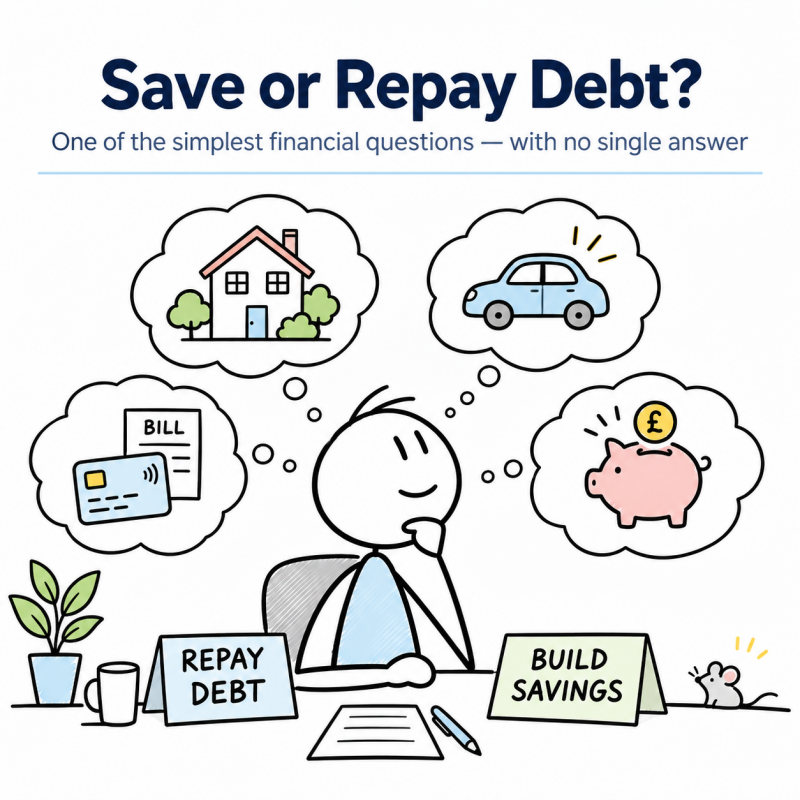
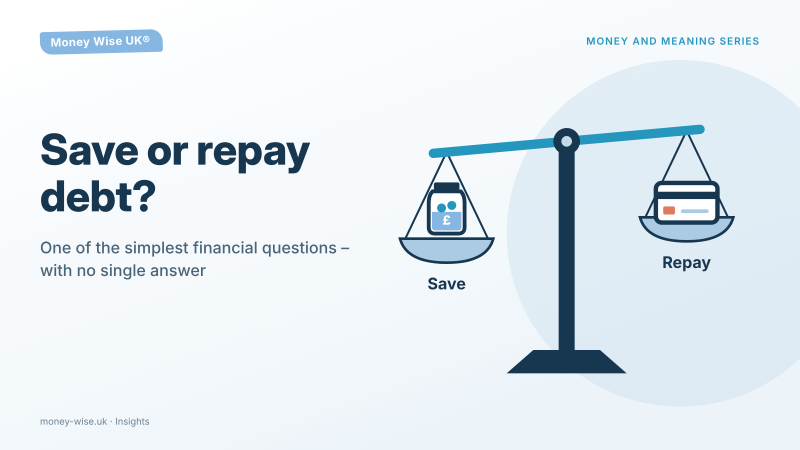
One of the simplest financial questions – with no single answer
In my last article, I wrote about budgets and why having a budget is not really about saying no. It is more about understanding your choices.
Can I afford this?
Do I need to save?
Am I making progress, or am I simply drifting from one month to the next?
A budget helps us understand what is coming in and what is going out. It can highlight areas where we may be able to reduce costs, but it can also show us how much spare income we have each month. That becomes especially important when we ask a very common question:
Should I save, or should I repay debt?
I help run CAP Money Coaching courses, and this is one of the topics that often comes up. For a long time, I was scared of debt. But over time I have come to see that it is important to understand the difference between good debt, controlled debt and debt that has become a problem.
It is also important to understand the role of savings.
Because there is no single answer that works for everyone.
Not all debt is the same
One of the mistakes we can make is to talk about all debt as if it is identical.
It isn't.
Some debt can help us buy something valuable and long term. Some debt can be manageable if used carefully. Other debt can become a burden that keeps growing and becomes difficult to escape.
That is why I think it helps to distinguish between different types of debt.
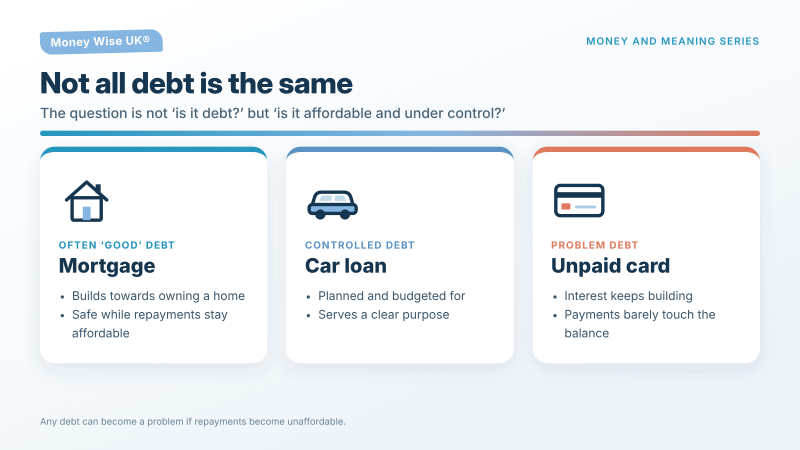
Mortgages: often seen as “good” debt
If we are able to buy a home, many of us will do so with the help of a mortgage.
Of course, if you add up all the interest paid over the lifetime of a mortgage, the total cost can be significant. It can feel as though you are paying far more than the original price of the house.
But there is another way of looking at it.
If you rent for many years, you may spend a great deal of money and still have no ownership at the end of it. With a mortgage, although you are paying interest, you are gradually working towards owning an asset.
That is why mortgages are often seen as a form of good debt.
That does not mean they are risk free. The key is whether the repayments are affordable and whether they can be maintained. If payments are missed and arrears build up, then a mortgage can quickly become a serious problem, because your home may be at risk.
So perhaps it is best to say that a mortgage is often a useful and necessary form of debt — provided it remains affordable and under control.
Controlled debt
Outside of a mortgage, there may be other forms of borrowing that can be manageable.
A good example might be a car loan or finance agreement.
For some people, a car is not a luxury but a necessity. It may be essential for getting to work, taking children to school or managing day-to-day life.
Again, the key issue is affordability.
Can you comfortably make the payments each month?
Have you allowed room in the budget for this commitment?
Would a change in circumstances make it difficult to keep up?
Controlled debt is not really about whether borrowing is “good” or “bad”. It is about whether it is planned, affordable and serving a clear purpose.
Uncontrolled debt
The real danger comes when debt starts to run ahead of us.
Many years ago, we paid for almost everything on a credit card. Then, when our income came in, we paid the card off.
On the surface, that seemed to work.
But in reality, we were chasing our tails. One small misstep — an unexpected bill, a change in income, a month where spending was a bit too high — and things could easily have unravelled.
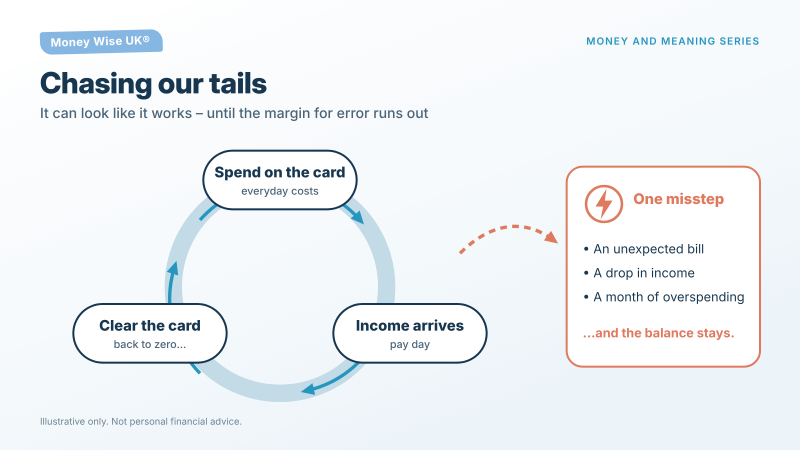
That is often how debt problems begin. Not always through recklessness, but because the margin for error becomes too small.
Using a credit card is not automatically a bad thing. Some people use them well, particularly when they clear the balance in full each month and benefit from cashback, points or purchase protection.
But if the balance is not cleared, and interest begins to build, the problem can quickly grow.
At that point, monthly payments may mainly be covering interest rather than reducing the amount owed.
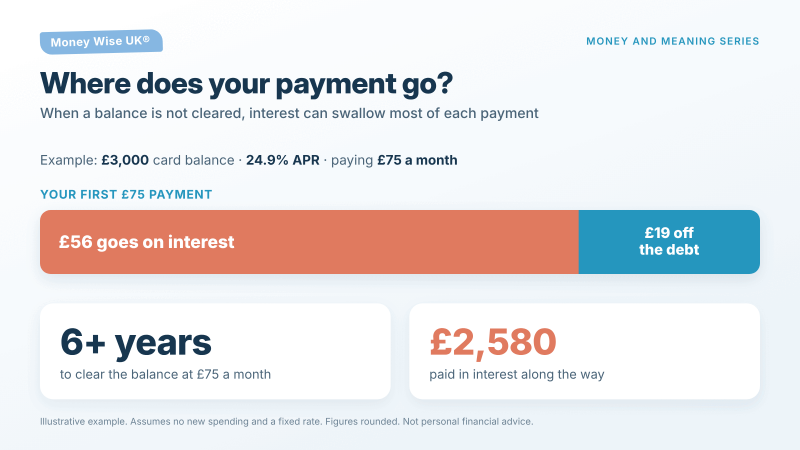
That is when debt can begin to feel like a weight that never gets lighter.
Savings matter too
When we ask whether we should save or repay debt, it is tempting to look for a simple rule.
But real life is rarely that simple.
In many cases, it makes sense to prioritise repaying the debts with the highest rates of interest first. If a credit card is charging a high rate, then reducing that debt may be one of the best financial decisions you can make.
But there is another side to this.
If we use every spare pound to repay debt and build up no savings at all, then what happens when something unexpected comes along?
A broken appliance.
A car repair.
A larger-than-expected bill.
A sudden drop in income.
Without any savings buffer, there is a danger that we simply go back into debt again.
That is why savings matter.
Even a small emergency fund can make a real difference. It creates breathing space and may help prevent short-term problems from turning into longer-term debt.
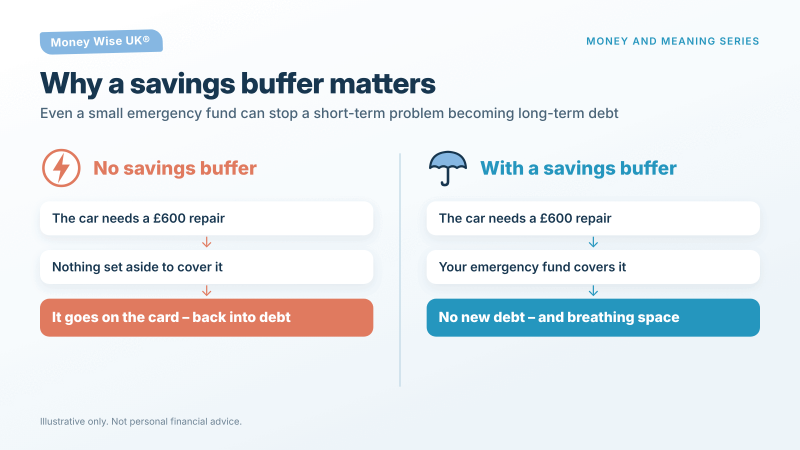
So, should you save or repay debt?
The honest answer is: it depends.
It depends on:
- the type of debt
- the interest rate being charged
- whether the debt is under control
- whether you already have some emergency savings
- how much spare income you have each month
- how secure your income is
- what level of financial pressure you are under
As a general guide, I would usually say this:
- Pay down expensive debt as a priority
- Try to build at least some savings buffer
- Use your budget to decide what is realistic
- Avoid thinking in extremes
This is not always an “either/or” decision.
For some people, the best answer may be to do both at the same time — paying extra towards expensive debt while also putting aside a small amount each month into savings.
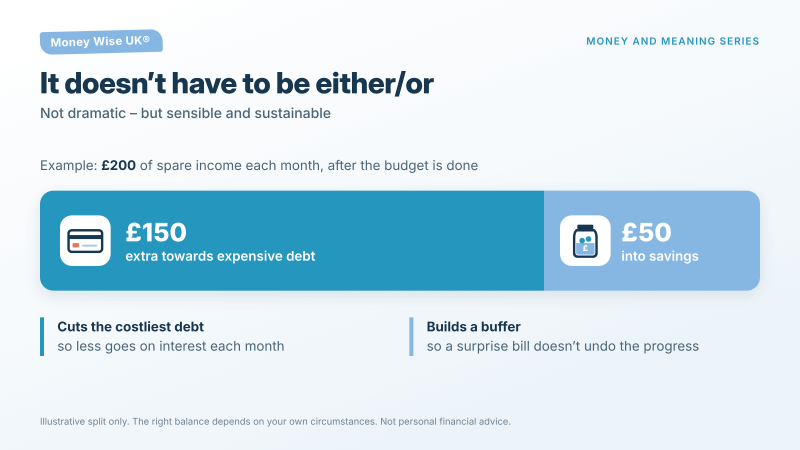
That may not feel dramatic, but it can be a sensible and sustainable way forward.
The budget is what makes this possible
This brings us back to the point of the previous article.
A budget helps you understand what is possible.
It shows what spare income you have, where there may be room to make changes and how much flexibility exists within your finances.
Without that, decisions about saving or debt can become guesswork.
With it, you are in a much better position to decide what to do next.
Taking control
Not all debt is bad.
A mortgage may help us buy a home. A car loan may help us get to work. A credit card may work perfectly well if it is used carefully and cleared each month.
The problem is not simply debt itself.
The problem comes when borrowing is unaffordable, poorly understood or begins to control us rather than serve us.
And that is why savings matter too.
Savings can help us avoid future debt, cope with the unexpected and feel more secure.
So if you are asking yourself whether to save or repay debt, the first step is not to panic.
The first step is to understand your position.
Look at your budget.
Understand your debts.
Know the interest rates.
Think about your need for a financial buffer.
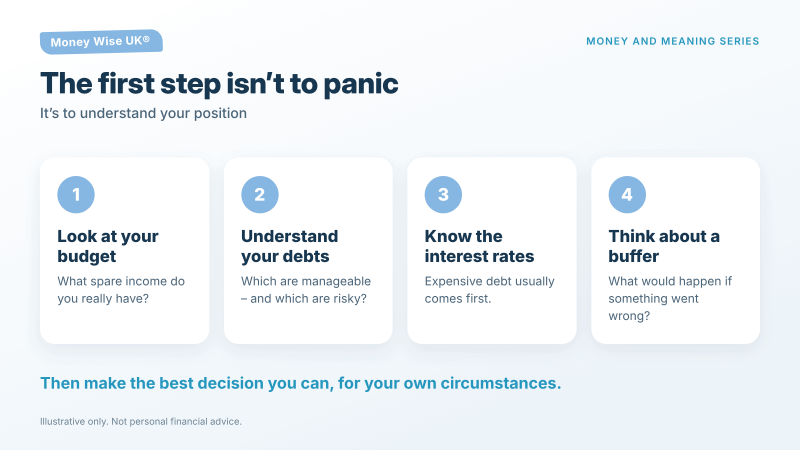
Then make the best decision you can, based on your own circumstances.
Because, as with so much in personal finance, the answer is not about perfection.
It is about making thoughtful choices with the resources you have.
Three questions to think about
- Do you understand the difference between your manageable debts and your more expensive or risky debts?
- Do you have any savings buffer in place for unexpected expenses?
- If you had some spare income each month, what balance between saving and repaying debt would feel right for you?
In the final article in this series, I will look at one last question:
Who is controlling who?
Because ultimately, money should be a tool we use — not something that quietly controls us.
This article is part of the Money Wise UK series inspired by my book Money and Meaning. It is intended to encourage reflection and discussion and does not constitute personal financial advice.
Add comment
Comments