
I recently wrote a blog looking at one of the most debated topics in retirement:
Should you generate retirement income by:
- Selling units from your investments?
or - Living off natural income such as dividends and bond income?
The response was fascinating.
Some people immediately jumped to the maths.
"If both portfolios return 7% and you withdraw 4%, what’s the difference?"
And mathematically… that is a fair challenge.
If two portfolios produce the same total return, and you withdraw the same amount, the spreadsheet may suggest there is little difference.
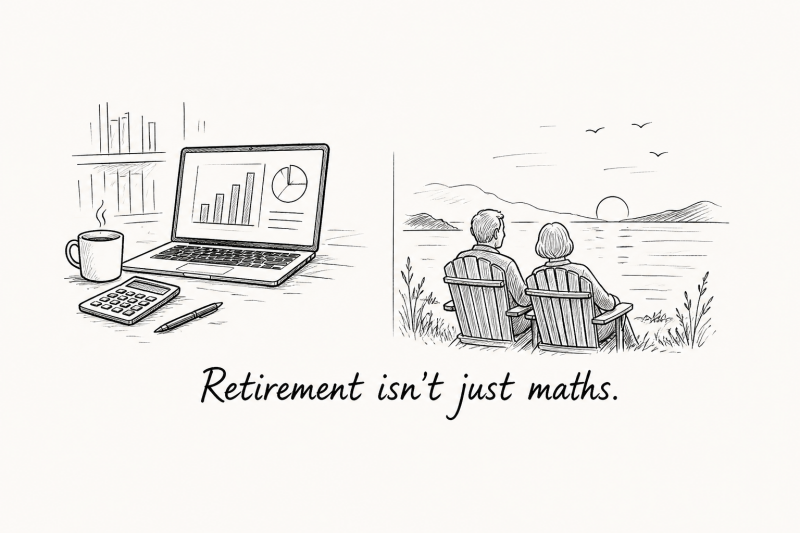
But retirement planning was never just about spreadsheets.
That is where I think our industry sometimes misses the point.
The Maths Matters… But Behaviour Matters More
I am not arguing with investment theory.
In fact, many of the responses were technically right:
High-dividend portfolios may underperform broader equity markets over the long term.
Dividends can be cut.
Bond coupons can change.
Tax rules can make one strategy more efficient than another.
And yes—there is no magic “4% portfolio” that rises neatly with inflation forever.
All true.
But here is my question:
What happens when a client sees their portfolio fall by 20% in retirement and their only income strategy is to sell units?
That is not a spreadsheet problem.
That is a human problem.
That is when behaviour enters the room.
Retirement Is Different from Accumulation
When you are building wealth, volatility feels different.
Markets fall… you keep contributing.
Time is on your side.
Retirement changes everything.
Now withdrawals begin.
Now headlines matter more.
Now emotions matter more.
Now people start asking questions like:
"Am I running out?"
"Should I stop spending?"
"Should I move to cash?"
"Did I retire too early?"
And this is where retirement income planning becomes far more than portfolio construction.
It becomes psychology.
The Real Question Is Not “Which Strategy Is Best?”
The real question is:
What helps this person stay invested and sleep at night?
For some people, selling units works perfectly.
They understand markets.
They trust the process.
They focus on total return.
For others, seeing income arrive naturally from dividends or bonds creates confidence.
They feel they are “living off the income” rather than “eating into capital.”
Technically, the difference may be small.
Behaviourally, it can be enormous.
And if a strategy helps someone avoid panic-selling in year three of retirement…
That strategy may be worth more than a few basis points of theoretical outperformance.
Retirement Planning Is Bigger Than One Chart
One of the other comments I received was fair:
"Is it realistic to assume someone retires at 65 and lives to 100?"
Probably not for everyone.
"What about volatility?"
Absolutely.
"What about tax, inheritance planning, other pensions, ISAs, property, spouses, care costs?"
Exactly.
And that is precisely the point.
A retirement income strategy should never be built around one chart.
It should be built around:
- Health
- Family
- Spending needs
- Tax position
- Capacity for loss
- Other assets
- Legacy wishes
- Emotional tolerance to volatility
Because retirement is not an investment problem.
It is a life planning problem.
My View
I am not anti-selling units.
I am not anti-natural income.
I am anti one-size-fits-all retirement planning.
Some people need efficiency.
Some need flexibility.
Some need certainty.
Some simply need confidence.
The real skill is not choosing between dividends or withdrawals.
The real skill is helping someone stay the course for 20, 30, or even 35 years.
Because in retirement…
the best strategy is often the one a person can actually live with.
Add comment
Comments