
When I started my consultancy two years ago, I didn’t expect that so much of my work—and writing—would focus on retirement.
Yet here we are.
A large part of what I now do with financial planning firms is helping them build structured retirement processes. The recent developments in the FCA’s advice framework only reinforce this direction, highlighting the opportunity for advisers to deliver something more meaningful than just products or projections.
At the same time, retirement itself has changed.
Very few people today can rely on guaranteed pension schemes. Responsibility has shifted. Decisions are more complex. And perhaps most importantly, retirement is no longer a single moment.
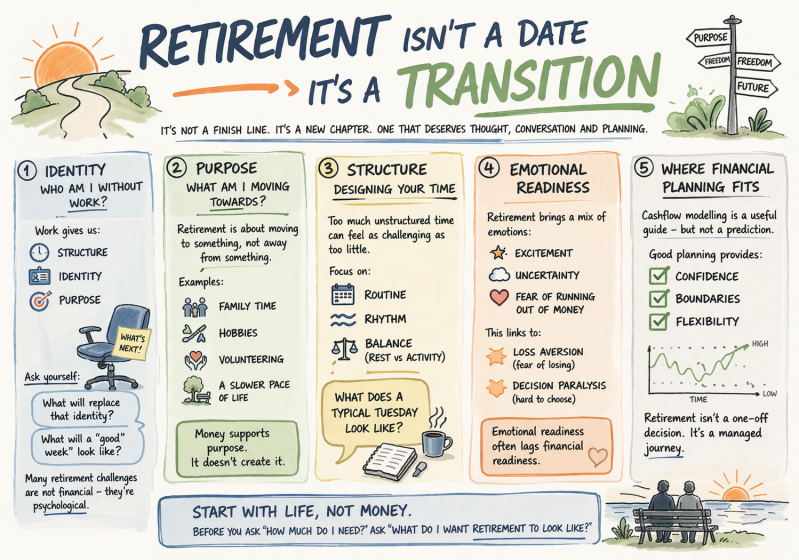
It is a transition.
Identity – Who Am I Without Work?
This is one of the most overlooked aspects of retirement—and one of the most important.
One day, you are “someone” in a professional sense. The next, that identity changes.
If you have ever been made redundant, you may have experienced a glimpse of this shift.
Work provides:
- Structure
- Identity
- Purpose
Retirement removes—or gradually reduces—these anchors.
In the questionnaires I have been developing, I often explore two simple but powerful questions:
- What will replace that identity?
- What will a “good week” look like?
These are not financial questions—but they are essential.
Because many of the challenges people face in retirement are not financial.
They are psychological.
Purpose – What Am I Moving Towards?
Retirement is often framed as something we are moving away from—work, stress, routine.
A more helpful way to think about it is this:
Retirement is something you are moving towards.
That might include:
- More time with family
- Hobbies or interests you’ve put off
- Volunteering or giving back
- A slower, more intentional pace of life
Without purpose, retirement can quickly shift from freedom to boredom.
Money plays an important role here—but only as a facilitator.
Money supports purpose. It doesn’t create it.
Structure – Designing Your Time
This is something I’ve been experiencing personally.
As I transition into working slightly less—freeing up one or two days a week—it becomes clear how important it is to think about how that time is used.
Because too much unstructured time can feel just as uncomfortable as too little.
Key considerations include:
- Routine
- Rhythm
- Balance between rest and activity
A simple but powerful question—whether you are an adviser or planning for yourself—is:
“What does a typical Tuesday look like?”
If that question is difficult to answer, it’s worth spending time there.
Emotional Readiness
One area that is often underestimated by both advisers and clients is the emotional side of retirement.
Common feelings include:
- Excitement
- Uncertainty
- Fear of running out of money
These emotions are closely linked to behavioural concepts such as:
- Loss aversion (the fear of losing what we have)
- Decision paralysis (struggling to act under uncertainty)
A key insight is this:
Emotional readiness often lags financial readiness.
You may be financially able to retire—but not yet feel comfortable doing so.
Where Financial Planning Fits
Financial planning plays a crucial role—but it needs to be positioned correctly.
Cashflow modelling, for example, is often presented as the solution. It is valuable—but it is not a prediction. It is a guide.
Used well, planning provides:
- Confidence
- Boundaries
- Flexibility
It helps answer questions like:
- “Can I afford to do this?”
- “What happens if things change?”
But it should always sit alongside the broader picture of life, purpose, and structure.
Retirement is not a one-off decision.
It is a managed journey.
In Summary
Retirement is not a finish line.
It is a transition that requires:
- Thought
- Conversation
- Planning
Whether you are approaching retirement yourself, or you are a financial adviser building a process for clients, the starting point should not be:
“How much money do I need?”
It should be:
“What do I want retirement to look like?”
Because once that is clear, the financial plan has something meaningful to support.
Add comment
Comments