

One of the questions I often come back to—whether I am working with financial planning firms, writing, or building Money Wise UK—is a simple one:
What do you believe your service is worth?
When I first started consulting, I charged £200 per day.
More than one person told me it wasn’t enough.
At the time, it wasn’t because I didn’t value what I could offer. It was because I was building something. I was building trust, building relationships, and building a reputation.
Today, my daily rate is considerably higher.
Not because I suddenly became more valuable overnight—but because I became clearer on the value I was delivering, and more confident in communicating it.
I faced a similar challenge when I published my book, Money and Meaning.
How do you price something you have poured your experience, mistakes, lessons, and beliefs into?
Price it too low and people may question its worth.
Price it too high and you wonder whether people will buy it.
It is a tension many professionals face.
Why Do We Question Some Fees… But Not Others?
Think about it.
If your electrics fail, you call an electrician.
If your accounts need sorting, you call an accountant.
If your boiler breaks, you call an engineer.
They tell you the cost.
Most people accept it.
They may not like it—but they understand expertise has value.
Yet in financial services, fees often become the headline.
Particularly when investing.
You will often see messages like:
“Even small differences in fees can reduce your pension by thousands over time.”
This argument is often used by firms such as Vanguard Group and others promoting low-cost investing.
And to be fair—there is truth in it.
Fees do matter.
But the conversation often stops there.
And that is where I think we have a problem.
The Fee Debate Is Often Missing Context
There are two important points people often overlook.
1. Investment performance is shown after charges
Whether you choose active funds or passive funds, fund performance is usually shown net of the underlying charges.
That means you can already see what the manager has delivered after costs.
So the real question is not simply:
“What am I paying?”
It is:
“What am I receiving for what I pay?”
2. There are always costs
Whether you invest through a DIY platform, an app, or with a financial planner, there will almost always be costs somewhere:
- Platform fees
- Fund charges
- Trading costs
- Advice fees (if advice is taken)
So the debate often ends up focused on one thing:
The fee charged by the financial planner.
And this is where things get interesting.
The Real Issue Isn’t Fees. It’s Confidence.
I meet financial planners who tell me:
- “The Financial Conduct Authority wants fees to come down.”
- “We need to reduce fees to stay competitive.”
- “Clients are becoming more fee-sensitive.”
Maybe.
But when I ask a simple follow-up question—
“Can you clearly explain the value you deliver?”
There is often silence.
Not because they do not add value.
But because many firms have never properly articulated it.
They talk about meetings.
They talk about reports.
They talk about investments.
But they struggle to explain the deeper value:
- Behavioural coaching during market falls
- Tax planning over decades
- Retirement income sustainability
- Helping families make better decisions
- Stopping costly emotional mistakes
- Bringing structure, clarity, and accountability
That is where the real value often sits.
Not always visible.
But hugely valuable over time.
Fees Do Matter—But Value Matters More
Yes, fees reduce the size of an investment pot.
That is a fact.
But focusing only on fees can miss something even more important:
The value of better decisions.
One poor tax decision.
One emotional investment decision.
One rushed retirement income strategy.
One failure to plan for later life.
Any one of those can cost far more than the advice fee itself.
There is growing evidence that good financial advice can improve long-term outcomes—not just financially, but emotionally and behaviourally too.
And that matters.
My View
If you are a financial planning firm, be transparent about your fees.
Put them on your website.
Explain them clearly.
But more importantly—
Show people what they get in return.
Because if we become obsessed with what we charge, we risk forgetting what we actually deliver.
And when we forget that…
Clients will too.
Final Thought
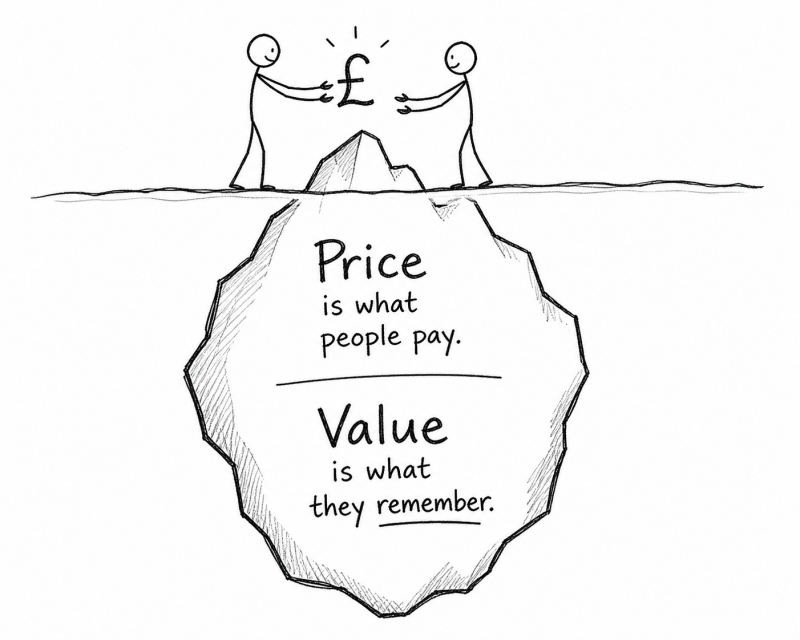
Price is what people pay.
Value is what they remember.
Add comment
Comments