
I had this discussion this week.
The pessimist in me says maybe.
The optimist in me says maybe not.
Am I sitting on the fence? Possibly. But during a podcast discussion recently I was reminded of something important: humans are remarkably adaptable and resilient.
History shows us that change is not new.
After the war, a significant proportion of the population worked in agriculture. As technology improved, farming became more efficient and required fewer people. Jobs changed, industries evolved and people adapted.
The same thing happened in offices.
When I first started working, calculators sat on every desk and typing pools were common. Today, most of us carry more computing power in our pockets than entire offices once had.
Technology changes what we do.
It does not necessarily remove the need for people.
AI feels like the latest chapter in that story.
Whenever I research something, I often start with a search engine. But searching can sometimes feel slow and frustrating. You click one article, then another, then another, trying to piece together information.
AI changes that process.
Ask the right questions and information can be organised, refined and presented far more quickly.
For me, working on my own, it feels less like replacing a person and more like having somebody sitting next to me handling some of the heavy lifting while I focus on refining, challenging and improving the output.
That has real implications.
AI may help develop tools that improve access to advice, particularly for people who traditionally may not have been able to afford support. That has to be positive.
Within financial planning businesses, I have already seen practical examples.
Recently I started building a cashflow tool and a bucketing tool using AI. Previously, developing something like that may have meant purchasing expensive software or relying on systems where you have little control over the inputs and outputs.
Now firms may increasingly be able to build solutions that work around their own process, their own clients and their own proposition.
That creates opportunities.
But there is an important distinction.
AI is powerful when you know what you are looking for.
It can process information, identify patterns and speed up tasks. But judgement, experience, empathy and understanding people remain very different skills.
Financial planning, for example, is rarely just about numbers.
It is often about understanding fears, relationships, behaviour and helping people make decisions during emotional moments.
Those things are harder to automate.
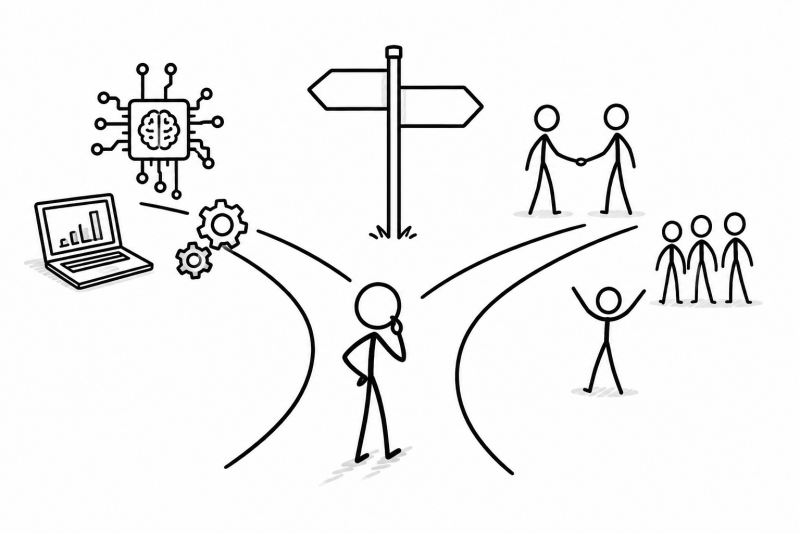
So back to the original question:
Is AI coming for your job?
Perhaps not.
But I do think many jobs will look very different in ten years.
The people who thrive may not necessarily be those who resist AI or blindly embrace it.
They may be the people who learn how to work alongside it.
Because throughout history, humans have not survived by avoiding change.
We have survived by adapting to it.
Money Wise UK View
AI may replace tasks.
It may even replace parts of roles.
But replacing human trust, judgement and relationships is a much harder challenge.
The future may not be humans versus AI.
It may be humans with AI versus humans without it.
Add comment
Comments