
Money and Meaning – Part One of Four
When I wrote Money and Meaning, I wanted to explore our relationship with money rather than simply how to accumulate more of it.
Over four short articles, I am going back to some of those basic ideas: why we struggle to talk about money, whether budgeting really matters, the tension between saving and debt, and ultimately whether we control our money or it controls us.
None of this is about telling people what they should do. It is about encouraging us to think about the role money plays in our lives.
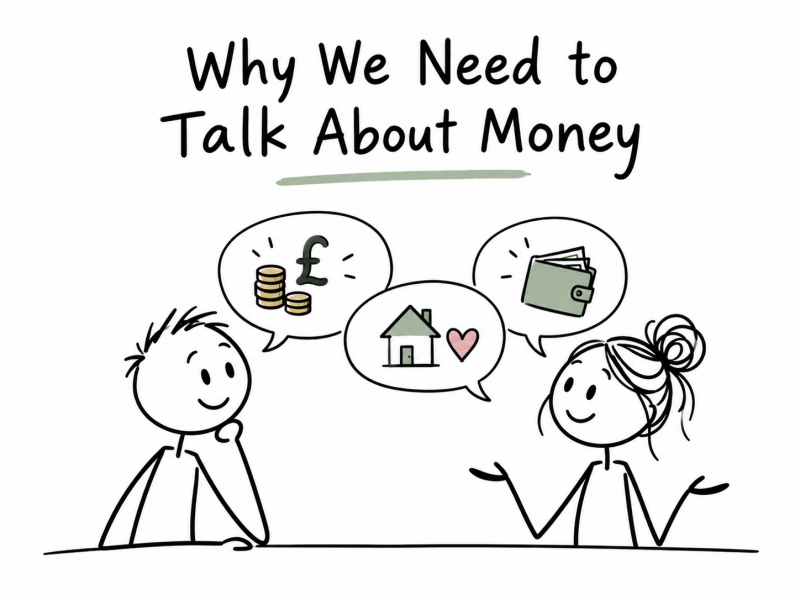
So let's begin with the first question: Why do we need to talk about money?
What is your relationship with money?
It is probably worth starting with a simple question.
What is your relationship with money?
And then asking yourself why that is the case.
Are you secretive about money, or are you happy to talk openly about it? Does money worry you or even scare you? Do you enjoy spending it, or does spending make you uncomfortable?
We all have our own relationship with money, and much of that relationship can be shaped by our upbringing and experiences.
Think about the messages you heard about money when you were growing up. Was money something people talked about openly? Was there always enough, or was it a constant source of worry?
Sometimes those experiences stay with us long after our financial circumstances have changed.
Our experiences shape our behaviour
I have come across people who have plenty of money but remain fearful of spending it. In fact, they sometimes paint a picture of being poor, even when their finances suggest otherwise.
That is not necessarily a bad thing. Being careful with money can be valuable.
But sometimes the fear comes from growing up in a household where there wasn't much money. Even when their circumstances have improved, that feeling of insecurity can remain.
On the other side, I have met people with very little money who are generous to a fault and seem to have few concerns about their finances.
Neither approach is necessarily right or wrong.
The point is that our financial circumstances do not always explain our financial behaviour.
And perhaps that is something we should think about more often.
Why talking about money matters
One area where our different attitudes towards money can create real difficulties is in our relationships.
Research by Royal London in 2022 found that 62% of people who argue with their partner had argued about money. A third of those surveyed also admitted to keeping financial secrets from their partner.
Relate has also highlighted research from Lloyds Bank in 2019 which found that 44% of UK adults had avoided talking about money with their partner.
Those are quite striking figures.
Money can create tension, not necessarily because there isn't enough of it, but because two people may have very different ideas about how it should be used.
One person may want to save every spare pound, while another may feel that money should be enjoyed today.
One might see debt as something to avoid at all costs, while another is comfortable borrowing.
And sometimes neither fully understands why the other feels that way.
I know couples who keep their finances separate. Their earnings remain their own, and they contribute towards shared expenses such as the mortgage, rent and household bills.
There is nothing necessarily wrong with that approach. For some couples, it works very well.
But having separate accounts doesn't remove the need to talk about money.
Do we understand each other's financial priorities? Do we know what worries the other person? Are we working towards the same goals?
Perhaps the most important part is not how we organise our bank accounts, but whether we feel comfortable having those conversations.
It is not just about couples
In Money and Meaning, I encourage people to talk more openly about money.
And that goes beyond our relationships with partners.
It includes our children, parents, friends and wider family.
Sometimes we don't have enough money to do everything we would like.
Perhaps friends suggest an expensive meal, a weekend away or an activity that we simply cannot afford.
It can be difficult to admit that.
We may feel embarrassed, worried about what others will think or under pressure to keep up with the people around us.
But why should we?
There should be nothing wrong with saying, "I would love to, but I simply cannot afford it at the moment."
Equally, we should be careful not to judge someone who makes a different financial decision from us. We rarely know the full story behind their circumstances.
Perhaps by talking more openly, we can begin to remove some of the pressure we place on ourselves and others.
Finding freedom in talking about money
I don't believe we need to share every detail of our finances with everyone.
Money is personal, and there are good reasons why some people prefer to keep their financial circumstances private.
But there is a difference between choosing to be private and feeling unable to talk.
The more we understand our own relationship with money, the easier it may become to recognise why we make certain decisions.
And the more willing we are to listen to other people's experiences, the better we may understand their choices.
Ultimately, I hope this series encourages us to think differently about money.
Not simply how much we have, how much we earn or how much we save.
But what money means to us, how it shapes our relationships and whether it gives us the freedom to live the lives we want.
Because perhaps the first step towards having a healthier relationship with money is simply being willing to talk about it.
Three questions to think about
If you have read this far, here are three questions I would encourage you to consider:
-
How do you think about money? What experiences from your childhood or adult life might have shaped those views?
-
What worries you most about money? Is it not having enough, spending too much, losing what you have or something else entirely?
-
Are you open or secretive about money, and why? Is that a conscious choice, or something you have simply grown accustomed to?
There are no right or wrong answers.
In the next article, I will explore budgeting. Not as something designed to stop us enjoying life, but as a way of understanding our money and making more informed choices.
This article is part of the Money Wise UK series inspired by my book Money and Meaning. It is intended to encourage reflection and discussion and does not constitute personal financial advice.
Research referenced
-
Royal London (February 2022), Love and money: Couples reveal they're poles apart.
-
Relate, Talking about money in your relationship, citing Lloyds Bank research (2019).
Add comment
Comments