

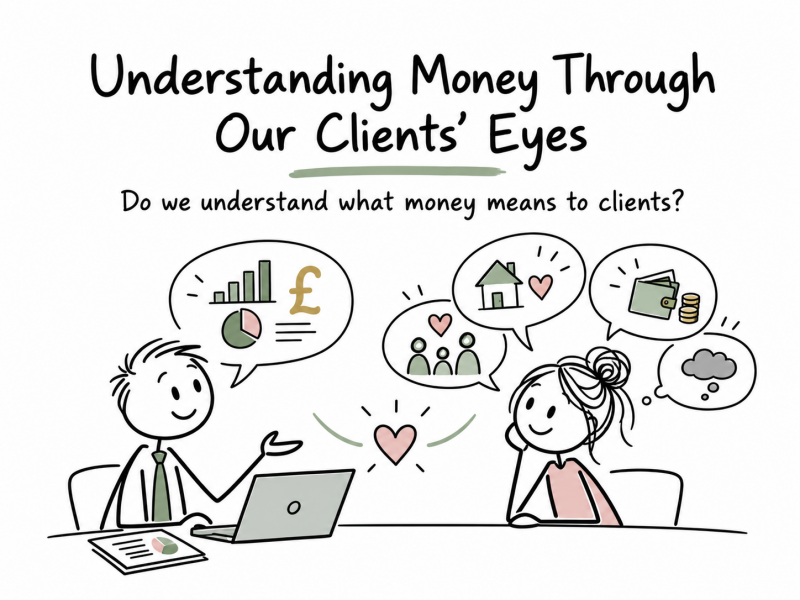
Understanding Money Through Our Clients' Eyes – Part One of Five
As financial professionals, we spend a great deal of time learning about money.
We understand investments, pensions, taxation, financial risk and the importance of planning for the future.
But how well do we understand what money actually means to the people sitting in front of us?
Our own experiences shape how we think about money. Our upbringing, family circumstances, careers, relationships and the challenges we have faced all play a part.
The same is true for our clients.
The difficulty is that we may never have experienced what they have experienced.
We might understand financial hardship in theory without ever having faced it ourselves. We might understand the mathematics of retirement without knowing what it feels like to give up a regular salary after 40 years of working.
And sometimes, without realising it, we can judge people's financial decisions through the lens of our own experiences.
Drawing on themes from my book Money and Meaning, this series explores why understanding people is every bit as important as understanding their money.
It isn't about suggesting that financial planners lack empathy or understanding. It is about recognising that technical knowledge and lived experience are two very different things.
Perhaps the most important question isn't always whether we have the right answer.
It is whether we have understood the person asking the question.
What do clients actually value?
I spend a lot of time working with financial planning firms.
I sit with advisers who show me the various tools they use. Cash-flow modelling software that can produce amazing charts, investment analysis that can look at portfolios in considerable detail, and technology that allows us to model a client's financial future.
All of this has a place, and much of it is incredibly valuable.
I also hear advisers talk about how clients value their technical knowledge, investment expertise and ability to construct a financial plan.
And I am sure many do.
But something interesting happens when I look at client reviews.
Often, the things clients highlight are very different.
They talk about someone being there when they needed them. Having someone who listens, takes the time to explain things and understands their circumstances.
They mention trust, reassurance, confidence and feeling that someone genuinely cares about them.
In other words, it is often the human side of financial planning that comes through most strongly.
This doesn't mean technical knowledge is unimportant. Far from it. Without technical competence, we cannot deliver good financial planning.
But perhaps technical knowledge is something clients expect us to have, while the relationship is what makes the experience valuable to them.
And that raises an interesting question.
Are we spending as much time developing our understanding of people as we are developing our technical knowledge?
Understanding experiences we have never had
This is perhaps one of the greatest challenges for financial planners.
Our own lives influence how we see the world.
Some of us may never have experienced unemployment, serious financial hardship or the worry of not knowing how we are going to pay the next household bill.
Others may have experienced these things but in very different circumstances from those facing our clients.
I remember when I found myself unemployed in 2009. Until that point, I had never experienced unemployment during my adult working life.
Walking into a benefits office opened my eyes to a world I had never really understood.
I knew unemployment existed. I understood the financial implications in theory. But experiencing it was something quite different.
And it changed how I thought about people's circumstances.
Now, consider the client sitting in front of us.
They may have spent much of their childhood worrying about money. They may have experienced debt, relationship breakdown, redundancy or the loss of someone who provided financial security.
Those experiences may have shaped their relationship with money in ways that are not immediately obvious.
A client with substantial wealth may still be frightened of spending it.
Another may want to repay their mortgage as quickly as possible, even when we can demonstrate that another approach might be financially advantageous.
A third may hold far more cash than we believe is sensible.
From a technical perspective, we may question these decisions.
But what if there is a perfectly understandable reason behind them?
Perhaps the client who holds too much cash remembers a time when they had none.
Perhaps the client determined to repay their mortgage grew up in a household where debt was a constant source of anxiety.
Perhaps the client who refuses to spend in retirement has spent 40 years worrying about financial security.
We cannot know unless we ask.
Two clients, the same wealth, very different people
Imagine two clients, both aged 65, retiring with £750,000 of investments and pensions.
On paper, their financial circumstances look remarkably similar.
But one grew up in a household where money was always tight. They have spent their working life saving carefully and avoiding unnecessary expenditure.
The other grew up financially secure, has enjoyed a successful career and sees money as something that should be used to enjoy life.
Both want to retire.
Both have broadly the same financial resources.
But their attitudes towards spending, investment risk and financial security could be completely different.
We could produce two almost identical cash-flow forecasts.
Would that mean we should deliver the same financial planning experience?
I would suggest not.
One client may need reassurance that they can afford to spend their money.
The other may need help understanding the importance of keeping enough back for later life.
The technical work may be similar, but the conversations could be very different.
This is why understanding the person matters.
Listening before providing solutions
Financial planning is built around understanding clients' needs, circumstances and objectives.
We have fact-finds, attitude-to-risk questionnaires, cash-flow forecasts and all manner of tools designed to help us gather information.
But these tools cannot tell us everything.
They cannot necessarily explain why someone is frightened of running out of money, why they feel responsible for supporting their adult children or why they are uncomfortable taking investment risk.
For that, we need conversations.
And sometimes we need to be willing to listen without immediately providing an answer.
That can be difficult when our professional instinct is to solve problems.
But perhaps the most valuable thing we can do at the beginning of a relationship is create an environment where clients feel comfortable talking about what money means to them.
Not simply how much they have, what they want to achieve or when they would like to retire.
But what worries them, what experiences have shaped them and what financial security actually means in their lives.
Of course, not everyone will want to share deeply personal experiences, and we should respect that.
The aim is not to turn financial planning into counselling.
It is to recognise that understanding someone's relationship with money may help us deliver financial planning that is more meaningful to them.
Understanding the person behind the numbers
I am not suggesting that technical expertise should become less important.
Quite the opposite.
Good financial planning requires sound technical knowledge, appropriate tools and well-researched recommendations.
But those things alone may not be enough.
We need to recognise that two clients with the same wealth can have completely different attitudes, priorities and fears.
We also need to accept that our own experiences do not necessarily reflect those of the people we advise.
That doesn't mean we cannot understand them.
It means we need to be curious, willing to listen and careful about making assumptions.
Perhaps, ultimately, financial planning is not simply about helping people make the best use of their money.
It is about understanding what their money means to them and helping them make decisions that reflect their lives.
Because we can understand everything about someone's finances without necessarily understanding the person.
Three questions to think about
As with the articles in my Money and Meaning series, I want to finish with three questions for reflection.
-
What do your clients really value about your service? Is that what you believe they value, or what they have actually told you?
-
How might your own experiences influence the way you approach financial planning? Are there circumstances you find difficult to relate to because you have never experienced them?
-
How well do you understand the person behind the numbers? Could you explain what financial security means to your clients, beyond the figures in their financial plan?
There are no simple answers, but I think these are questions worth considering.
Coming next: Are We Asking the Right Questions About Money?
In the next article, we will explore why financial planning should go beyond the traditional fact-find. We will consider how conversations about childhood experiences, debt, family responsibilities, financial security and personal fears can help us develop a deeper understanding of the people we work with.
This article is part of the Money Wise UK series Understanding Money Through Our Clients' Eyes, drawing on themes from my book Money and Meaning. It is intended to encourage reflection and discussion among financial planning professionals.
Add comment
Comments