

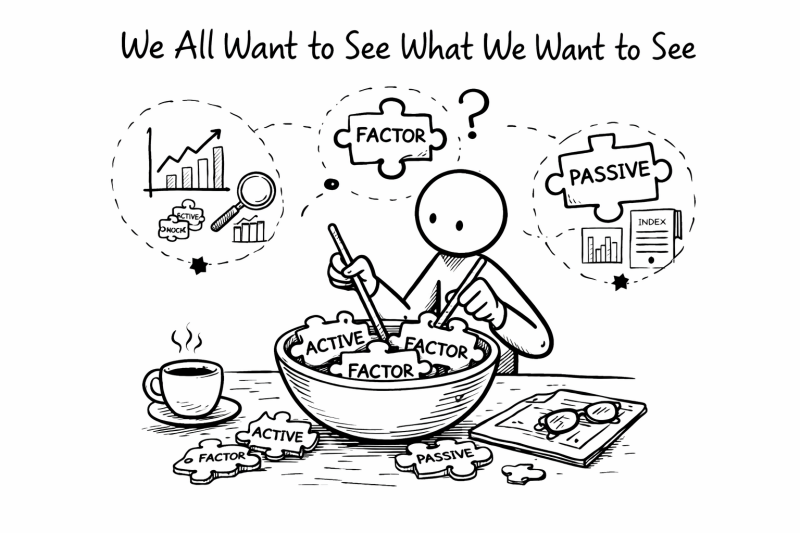
I have written about this before, but it is worth revisiting.
Confirmation bias is one of the most dangerous forces in investing.
Not because it is rare, but because it is everywhere.
We all fall into it.
The real danger is not that we are wrong.
It is that we only seek information that proves we are right.
The Problem with Confirmation Bias
In investing, it is very easy to build a narrative.
We find evidence that supports our beliefs.
We follow people who think like us.
We interpret outcomes in a way that reinforces our position.
Over time, that narrative becomes conviction.
And conviction, if left unchecked, becomes rigidity.
Experience Shapes Belief (But Can Also Limit It)
For over 10 years, I ran portfolios for a financial planning firm using predominantly active funds.
Over the long term, we outperformed our benchmarks.
Towards the end, we went through a more challenging period, but overall, we could demonstrate value.
It would be easy to label that experience.
“Active bias.”
And perhaps that is fair.
But the real lesson was not that active management works or doesn’t work.
It was that outcomes are rarely as simple as the story we attach to them.
The Rise of “One True Way” Investing
What I see increasingly in the market are strongly held views presented as certainty.
Some firms position their approach as the answer.
No grey areas.
No acknowledgement of uncertainty.
No discussion about what happens when things don’t work as expected.
“Our way or the highway.”
To be fair, there is logic behind this. Every investment house has a philosophy, and often a commercial model that supports it.
For example:
- Dimensional Fund Advisors have built a compelling case around factor-based investing, targeting long-term drivers of return such as size, value, and profitability
- Timeline focus on systematic, rules-based investing, emphasising discipline and consistency
Each of these approaches has merit.
Each is supported by research, experience, and conviction.
But none of them are infallible.
Factor, Passive and Active – Strengths and Limitations
One of the risks in today’s market is oversimplification.
Different approaches solve different problems.
- Factor investing has strong academic grounding and long-term evidence.
But it can go through extended periods of underperformance, which can be difficult for investors to stay committed to - Passive investing offers cost efficiency and simplicity.
But it can lead to concentration in the largest companies and sectors, particularly in market-cap weighted indices - Active management can adapt to changing conditions and exploit inefficiencies.
But it introduces manager risk and can be inconsistent
None of these are “right” or “wrong.”
They are tools.
The Most Valuable Insight: Blending, Not Choosing
One of the most useful conversations I have had on this came from a podcast.
I asked a simple question:
“Active or passive?”
The response was simple.
“Both.”
Not as a compromise.
But as a recognition that different approaches work in different environments.
The question is not:
Which approach is right?
It is:
How do they work together?
What This Means for Clients
Clients do not experience markets in isolation.
They experience outcomes.
And those outcomes are shaped by more than just returns.
They are shaped by:
- sequencing of returns
- behaviour during periods of uncertainty
- portfolio structure
- flexibility of income and withdrawals
This is where financial planning matters more than investment ideology.
Because a well-constructed plan does not rely on one approach being right.
It is built to withstand periods where different approaches behave differently.
Stepping Outside the Box
If we become too fixated on one way of thinking, the walls start to close in.
And when that happens, we stop seeing opportunities.
Or worse, we stop seeing risks.
Stepping outside of that mindset has been one of the most valuable lessons for me.
Not just professionally, but personally.
My own portfolio reflects that.
It is not built on a single belief.
It is built on an acceptance that different approaches can add value at different times, for different reasons.
Final Thought
We all want to see what we want to see.
The challenge is making sure we are not missing what we need to see.
FAQs
Is active or passive investing better?
Neither is inherently better. Active and passive approaches serve different purposes and can complement each other within a diversified portfolio.
What is factor investing?
Factor investing is an evidence-based approach that targets specific drivers of return, such as value, size, or profitability, often used within systematic investment strategies.
Why is diversification of investment styles important?
Different investment styles perform differently over time. Blending approaches can help create more consistent outcomes and reduce reliance on any single strategy.
How does confirmation bias affect investors?
Confirmation bias can lead investors to favour information that supports their existing beliefs, potentially causing them to overlook risks or alternative strategies.
Add comment
Comments