

We process an enormous amount of information in financial services.
Regulations. Compliance papers. Consultations. Guidance. Policies. Procedures. Investment research. Tax changes. Product updates.
To cope with the volume, the industry has become incredibly good at building recipes.
Follow step A. Add product B. Complete document C. Record evidence D.
It is structured. It is orderly. And, importantly, it provides consistency.
There is nothing inherently wrong with that.
The problem comes when following the recipe becomes more important than understanding whether the end result actually works for the client.
And that, I think, is one of the most important challenges presented by Consumer Duty.
My Brain Doesn't Naturally Follow the Recipe
I have dyslexia.
For a long time, particularly in the traditional corporate world, I probably saw that mainly as something I had to work around.
Today, I increasingly see the way I think as an advantage.
I don't naturally start at line one and work methodically towards line ten. I tend to stand back, look at the whole picture, make connections and then ask questions.
Why are we doing this?
What happens if we change that?
Does this actually work?
What are we missing?
It can sometimes make rigid processes frustrating. But when dealing with financial planning, investments, retirement and regulation, that different perspective can be incredibly useful.
Because clients don't live their lives in neat, sequential boxes.
Consumer Duty Changes the Question
Consumer Duty requires firms to act to deliver good outcomes for retail customers. Its framework incorporates the four outcomes of products and services, price and value, consumer understanding and consumer support.
But there is something more fundamental sitting underneath those words.
The question is no longer simply:
"Did we complete the process?"
It is:
"What happened to the customer?"
That is a subtle but significant difference.
The FCA expects firms to assess, test, understand and evidence the outcomes customers are receiving. It also expects firms to identify where different groups of customers may be experiencing different outcomes.
That means a perfectly completed process does not automatically equal a good outcome.
You can standardise a process.
You can standardise your documents.
You can standardise your investment proposition.
You can standardise your review framework.
But you cannot assume that standardisation will produce the same outcome for every human being who passes through it.
The Recipe Is the Starting Point, Not the Destination
This doesn't mean firms should throw away their processes.
Quite the opposite.
Good governance needs structure.
A chef needs a recipe before deciding whether it needs adapting. A financial planning firm needs policies, processes, controls and centralised propositions before individual judgement can be applied safely.
The recipe gives us the core ingredients and boundaries.
The creativity comes in understanding how they should be applied.
Consider two clients.
Both are 65.
Both have £750,000 invested.
Both want £40,000 a year.
On a spreadsheet they may initially look remarkably similar.
But one might have a defined benefit pension covering most essential expenditure, significant cash reserves and children who are financially independent.
The other might have no guaranteed income beyond the State Pension, a mortgage remaining, children who still require financial support and considerable anxiety about investment markets.
The numbers may be similar.
The people are not.
A retirement process that simply says "£750,000 portfolio + £40,000 withdrawal = solution X" has missed the most important part of financial planning.
The client.
Retirement Planning Makes This Particularly Obvious
Perhaps this is why I keep coming back to retirement planning.
Accumulating money can lend itself relatively well to a recipe.
How much can you save?
What tax wrappers are available?
What investment approach is appropriate?
What level of risk can you accept?
There are still plenty of complexities, but the broad direction is usually clear: build capital for the future.
Retirement changes the question.
Now we are asking that capital to do something.
It may need to provide income.
It may need to cover unexpected expenditure.
It may need to provide security for a surviving spouse or partner.
It may need to fund gifts to children.
It may need to survive market falls.
It may need to last for 30 or 40 years.
And increasingly, clients may not even have a conventional retirement date. They may reduce their hours, consult, start another business, help with grandchildren or move between periods of work and leisure.
Where is the standard recipe for that?
There isn't one.
There can be a centralised retirement proposition providing the framework, governance, research and processes.
But the proposition should help advisers make better decisions.
It shouldn't make the decisions for them.
Creativity Is Not the Opposite of Compliance
This is an important distinction.
When I talk about creativity, I am not suggesting financial planners should ignore their processes because they think they know better.
Consumer Duty isn't an invitation to make things up as we go along.
Creativity has to operate inside good governance.
Perhaps the better way to think about it is:
Governance creates the boundaries. Professional judgement operates within them. Outcomes tell us whether it worked.
That last part matters.
One of the areas I have spent considerable time thinking about since Consumer Duty was introduced is data.
Data allows us to stand back and ask questions.
Are certain clients disengaging?
Are vulnerable clients experiencing different outcomes?
Are clients actually using the services they are paying for?
Are people understanding the communications we send them?
Are retirement clients withdrawing more than we expected?
Are complaints telling us something?
Are there clients repeatedly cancelling reviews?
Are some parts of our proposition producing different results from others?
This is where Consumer Duty becomes much more interesting than another compliance exercise.
The FCA's July 2026 commentary on outcomes monitoring makes a similar point: understanding outcomes is about more than collecting information and producing reports. The purpose is to understand customers' actual experiences, identify risks and take action where appropriate.
Data should start conversations, not end them.
The Danger of the Green Tick
Financial services loves a green tick.
Policy reviewed? ✓
Annual review offered? ✓
Fair value assessment completed? ✓
Client communication sent? ✓
Consumer Duty report produced? ✓
The problem is that green ticks measure activity remarkably well.
They don't necessarily measure outcomes.
Imagine a firm records that 98% of clients were offered an annual review.
Excellent.
But what if only 60% attended?
What happened to the other 38%?
Perhaps some consciously decided they didn't need one. That may be perfectly reasonable.
But perhaps others didn't understand why the meeting mattered.
Perhaps some repeatedly cancelled.
Perhaps vulnerable clients were disproportionately represented among those not engaging.
Perhaps the communication was sent, but nobody checked whether the client understood it.
The first question gives us a comforting green tick.
The second set of questions may actually tell us something useful.
That is where curiosity matters.
Compliance Needs Curiosity
I think one of the unintended benefits of Consumer Duty is that it should encourage firms to become more curious.
Not less compliant.
More curious.
Instead of simply asking:
"Have we complied?"
Perhaps we should also ask:
"What is this telling us?"
If 10 clients behave differently, why?
If one adviser has significantly higher disengagement than another, why?
If clients regularly telephone after receiving a particular letter, is the communication really working?
If nobody uses a particular part of an ongoing service, does it genuinely provide value?
If retirement clients consistently underestimate expenditure, should the planning process change?
None of those questions necessarily means something is wrong.
But they create the opportunity to learn.
And learning creates the opportunity to improve outcomes.
Process + Judgement + Evidence
Perhaps the future of good financial planning isn't choosing between recipes and creativity.
We need both.
Process provides consistency.
Professional judgement provides personalisation.
Data provides evidence.
Curiosity drives improvement.
Put those together and Consumer Duty starts to look less like a compliance burden and more like a framework for building better financial planning businesses.
The FCA itself describes the Duty as moving beyond compliance checklists and putting fairness, transparency and customer-centricity into firms' interactions with consumers.
That doesn't mean every client needs a completely bespoke financial universe.
Nor does it mean centralised propositions are wrong.
Centralisation can provide valuable consistency, governance and efficiency.
But centralisation should provide the framework, not remove the thinking.
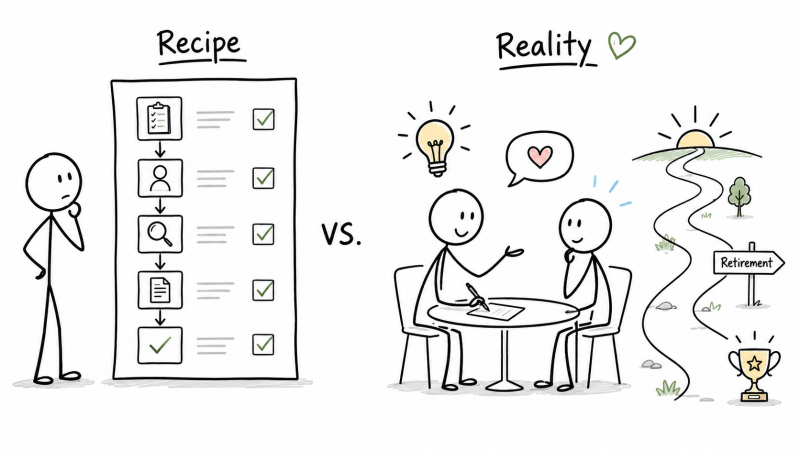
Recipes vs Reality
Financial services absolutely needs rules.
It needs governance.
It needs repeatable processes.
It needs evidence.
These things protect clients and protect firms.
But real life will always be messier than the recipe.
Perhaps my dyslexia means I naturally feel more comfortable with that messiness. I like standing outside the process, looking back in and asking whether all the pieces actually connect.
That is increasingly how I think firms need to approach Consumer Duty.
Build the recipe.
Understand the ingredients.
Put sensible controls around it.
Then look beyond the process at the person standing in front of you.
Because ultimately the objective isn't simply to demonstrate that every box was ticked.
It is to demonstrate that the financial planning process helped deliver a genuinely better outcome for the person who trusted us with their future.
Disclaimer: This article is intended for financial professionals and is for general information only. It does not constitute financial advice or a recommendation to use any particular retirement product, investment strategy or provider. Firms should carry out their own research and due diligence and consider the needs and circumstances of individual clients.
Add comment
Comments