

I am on something of a mini mission.
I want to encourage more financial planning firms to engage properly with retirement planning.
Why? Because I believe there is a distinct difference between helping someone accumulate assets and helping them use those assets to generate a sustainable retirement income.
Accumulation is largely about building wealth for the future. Retirement planning is about turning that wealth into income, security, flexibility and, where appropriate, a legacy.
That requires a different conversation, a different process and potentially a different investment approach.
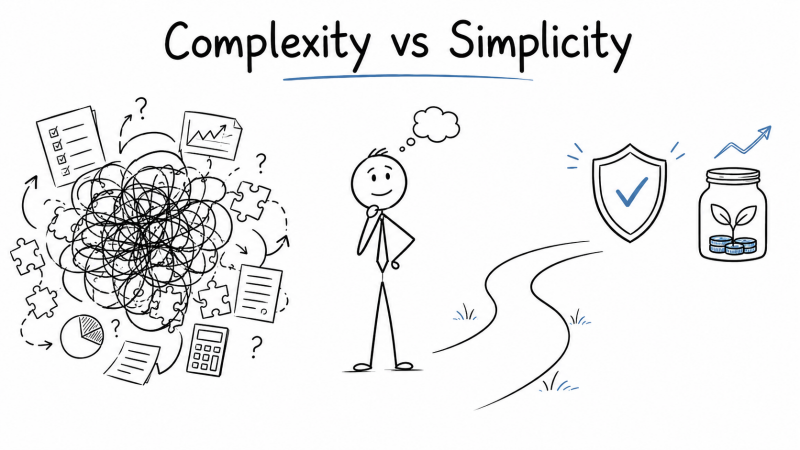
However, as the retirement market develops, I am becoming increasingly concerned that complexity is sometimes being presented as innovation.
A retirement proposition is not a retirement product
Before looking at retirement income solutions, it is important to distinguish between a Centralised Retirement Proposition, or CRP®, and the products or investments used within it.
Some firms claim they can provide a Centralised Retirement Proposition when what they are really offering is a retirement product, investment strategy or income solution.
The two are not the same.
A retirement solution might be an annuity, a drawdown portfolio, a guaranteed income product, an investment strategy or a combination of these.
A Centralised Retirement Proposition is the wider framework within which those solutions are researched, assessed and recommended.
It should consider areas such as:
-
The firm’s retirement advice philosophy
-
How clients’ essential and discretionary expenditure is assessed
-
The risks associated with withdrawing income
-
How sustainable income is evaluated
-
The role of guaranteed and flexible income
-
Capacity for loss and sequencing risk
-
Investment governance and product research
-
Tax planning
-
Reviews, monitoring and ongoing client communication
-
The documents and evidence needed to support suitable recommendations
A template can provide a useful starting point, but a genuine retirement proposition must be shaped around the needs, resources, clients and advice process of the individual financial planning firm.
This is no different from a client seeking financial advice. The client may begin with a general need, but the eventual recommendation should be tailored to their circumstances.
The proposition establishes the process. The retirement solution sits within it.
A lesson from a unit-linked annuity
More than 20 years ago, I was involved in the development of a unit-linked annuity.
The idea was to provide an income that was linked, at least in part, to investment market returns.
On paper, it appeared to provide an attractive combination of retirement income and investment growth.
We sold almost none.
There were several reasons for this. Our annuity rates were not particularly competitive, but I also believe the product was simply too complicated.
It may have made sense to the people who designed it, but that did not necessarily mean it made sense to financial advisers or their clients.
That experience has stayed with me.
When providers develop new retirement products, they often begin with what they believe the market needs. In trying to solve every possible retirement problem, they can end up building something that is difficult to explain, difficult to compare and difficult for the client to understand.
Sophistication is not necessarily a problem. Unnecessary complexity is.
The two main foundations of pension income
In simple terms, there are two primary ways of generating an income from a pension: an annuity and pension drawdown.
There are variations, combinations and additional solutions available, but these remain the two main foundations.
1. An annuity
With an annuity, the client exchanges part or all of their pension fund for an income.
Depending on the type of annuity selected, that income may be guaranteed for life.
The basic concept is relatively straightforward:
You give up access to a capital sum in return for a promised income.
The complexity tends to come from the additional options that can be included. These might include:
-
An income that increases over time
-
A minimum guarantee period
-
Income continuing to a spouse or dependant
-
Capital protection
-
Enhanced terms based on health or lifestyle
Each additional feature is likely to affect the starting level of income.
The important point is that the client understands the exchange they are making. They are giving up some or all of their pension capital in return for certainty of income.
For the right client, an annuity can be a valuable and effective solution. It can help cover essential expenditure, reduce the risk of running out of money and remove some of the worry associated with investment markets.
2. Pension drawdown
With pension drawdown, the client keeps their pension invested and withdraws money from it to provide an income.
Again, the basic concept is relatively simple:
The pension remains invested, and withdrawals are taken from the fund.
The management of drawdown is more complex because the income is not normally guaranteed.
The client and adviser need to consider:
-
How much income can reasonably be withdrawn
-
How long the fund may need to last
-
Investment returns
-
Inflation
-
Market falls
-
The order in which returns are experienced
-
Changes in expenditure
-
Tax
-
Longevity
-
The client’s ability to accept changes in income
Income might be generated from dividends and interest, sometimes described as natural income. Alternatively, investments may be sold to provide the required withdrawals. Many strategies will use a combination of the two as part of a total-return approach.
The concept of drawdown should still be understandable. The ongoing planning and management may be sophisticated, but the client should be able to explain where their income comes from and what could cause the plan to change.
Annuity versus drawdown is not always the right argument
The retirement income debate is often presented as annuity versus drawdown.
In reality, the answer does not have to be one or the other.
A client might use an annuity to meet essential expenditure while retaining a drawdown fund for flexibility, discretionary spending and potential inheritance.
The right balance will depend on the client’s circumstances, priorities and attitude towards certainty.
Beneficiaries may also become a more important part of this discussion.
How might a beneficiary feel if they discover that a pension fund has been depleted through years of drawdown?
On the other hand, how might they feel if a substantial pension fund was used to buy an annuity and little or no capital remained when the client died?
Neither outcome is automatically wrong.
A pension should primarily be used to support the person whose pension it is. However, where passing on wealth is important to the client, the potential consequences should form part of the discussion.
This is another reason why retirement advice cannot focus only on the product.
The adviser needs to understand what the money is for.
Retirement planning is wider than pension income
Retirement planning has many different angles.
It may involve:
-
Pensions
-
ISAs and other investments
-
Cash
-
Property
-
State Pension benefits
-
Tax planning
-
Gifting
-
Inheritance
-
Long-term care
-
Supporting children or grandchildren
-
Changes in health
-
Different stages of retirement
The role of advice is to bring these areas together.
The product is only one component of the plan.
A retirement solution may perform exactly as designed and still fail to deliver a good outcome if it does not reflect the client’s wider circumstances.
How to test a retirement income solution
When a provider presents a product or investment strategy that has been designed specifically for retirement, it is worth slowing down before accepting the claims made for it.
Here are four questions I would encourage firms to consider.
1. Can you understand the literature?
Read the product literature carefully.
Can you explain how the solution works, where the income comes from, what the charges are and what might cause the outcome to change?
Then consider giving the literature to someone who does not work in financial services.
Can they understand it?
Clients do not need to understand every technical detail, but they should understand the central features, risks and trade-offs.
2. Can you explain it in your own words?
Write down how you believe the solution works.
Describe:
-
What the client is investing in
-
How income is produced
-
What guarantees are provided
-
What is not guaranteed
-
What the client is giving up
-
The circumstances in which the solution might disappoint
Then ask the provider to confirm whether your explanation is correct.
This can be an effective way of identifying misunderstandings before the solution is used with clients.
3. Can you break the solution?
If something appears to be the perfect retirement solution, try to break it.
Consider what might happen if:
-
Markets fall shortly after the investment is made
-
Inflation remains higher than expected
-
The client lives considerably longer than planned
-
The client dies earlier than expected
-
Income requirements increase
-
The provider changes the terms
-
The solution becomes difficult to sell or transfer
-
Tax rules change
-
The client wants to leave the arrangement
A solution should not only be assessed under favourable conditions.
Good due diligence considers what might go wrong and whether those risks are acceptable.
4. Is there a simpler way to achieve the same outcome?
This may be the most important question.
Can the same client objective be achieved using a simpler combination of existing solutions?
For example, could a blend of guaranteed income, cash and conventional drawdown provide a similar outcome with greater transparency?
A more complicated product may be appropriate, but its additional complexity should deliver a clear and identifiable benefit.
Complexity should earn its place.
Sophisticated planning, simply explained
Retirement is one of the most important areas of financial planning.
As more people reach retirement with defined contribution pensions, providers will continue to develop products designed to capture this growing market.
Some will be excellent. Some will solve genuine client problems. Others may package familiar ideas in a more complicated form.
Financial planning firms should therefore begin with their retirement philosophy, advice process and client needs—not with the latest product launched by a provider.
Research the solution.
Challenge the assumptions.
Understand what the client is gaining and what they are giving up.
Most importantly, make sure you can explain it clearly.
Retirement planning can be sophisticated without being confusing.
If a financial professional struggles to understand a solution, we should stop and consider how it might feel to the client.
Frequently asked questions
What is a Centralised Retirement Proposition?
A Centralised Retirement Proposition, or CRP®, is a firm-wide framework for delivering consistent retirement advice. It covers the advice process, client segmentation, income planning, risk assessment, investment governance, product research, documentation and ongoing reviews. It is broader than an individual retirement product or investment solution.
What is the difference between an annuity and pension drawdown?
An annuity normally involves exchanging pension capital for an income, which may be guaranteed for life. Pension drawdown keeps the pension invested and allows the client to take withdrawals, but the level and sustainability of income will depend on factors including investment performance, withdrawals, charges and longevity.
Can an annuity and pension drawdown be used together?
Yes. A client may use an annuity or other guaranteed income to cover essential expenditure while retaining part of their pension in drawdown for flexibility, discretionary expenditure and potential inheritance.
Why can complex retirement products be a concern?
Complex products can be harder to understand, compare, research and explain. Complexity is not automatically bad, but it should provide a clear benefit that could not reasonably be achieved through a simpler solution.
What should financial planning firms consider before adopting a retirement solution?
Firms should understand how the solution works, its charges, risks, guarantees, liquidity, tax treatment and potential outcomes. They should also assess how it fits within their retirement advice process and whether a simpler alternative could meet the same client need.
Disclaimer: This article is intended for financial professionals and is for general information only. It does not constitute financial advice or a recommendation to use any particular retirement product, investment strategy or provider. Firms should carry out their own research and due diligence and consider the needs and circumstances of individual clients.
Add comment
Comments