
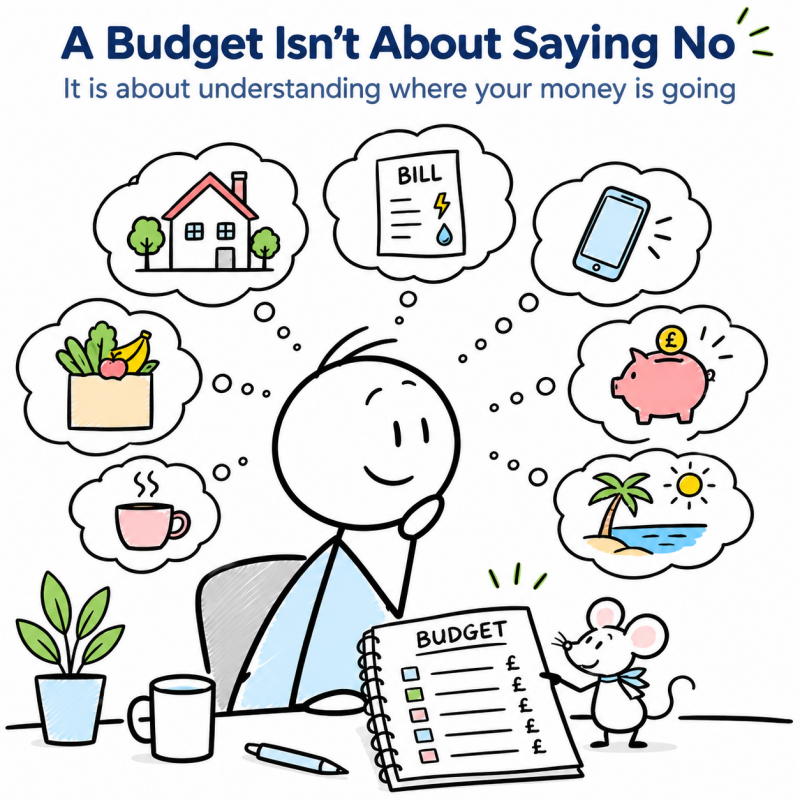
It is about understanding where your money is going
In the first article in this series, Why We Need to Talk About Money, I explored how our upbringing and experiences can shape the way we think about money.
For some, money feels uncomfortable to talk about. For others, it can create worry, embarrassment or even shame. I have seen this awkwardness first hand when someone does not have the same level of money as their friends and struggles to keep up, yet never feels able to say anything.
That is one reason why talking about money matters.
In this second article, I want to look at something practical: budgeting.
And in the next article, I will go on to explore another common question: should we save, or should we repay debt?
Why do people dislike budgets?
For many people, the word budget feels restrictive.
It can sound as if someone is telling us what we cannot do. You have £100 to spend, so that is your limit. No more.
It is easy to see why people react against that.
But I would argue that a budget is not really about restriction. It is about information and choices.
A budget helps us understand what is coming in, what is going out and what room, if any, we have to make different decisions.
Without that understanding, it is very difficult to feel in control.
A lesson from my early years
I still remember my first pay packet. It was £350 a month.
My rent was £200 a month.
That left me with £150 for everything else, including food.
If I went out for a drink, I had less money for food. It was simple maths.
I do not say that to seek sympathy. Many people have had it far harder. But it was an important lesson. It taught me very early on that money is often about choices.
In time, I moved to a different part of town where the rent was £100 a month. That made a real difference.
The lesson was not simply that I had little money. It was that once I understood where my money was going, I could make decisions.
That, to me, is the value of a budget.
A lot has changed, but the principle is the same
Of course, a lot has changed since I first started out.
Back then, life was simpler in some ways. The essentials were fewer. Rent, food and a handful of bills covered most of it.
Today, many people face a much wider range of regular costs. Mobile phone contracts, broadband, streaming subscriptions, insurance, rising energy bills and much more.
The list of outgoings has grown.
But the thinking behind budgeting has not changed.
A budget still helps us answer important questions:
-
How much can I afford to spend?
-
How much can I save?
-
Can I reduce any of my regular costs?
-
Can I save towards something important, such as a holiday or an emergency fund?
-
Am I living within my means, or constantly feeling behind?
In other words, a budget helps us plan.
And planning often brings a greater sense of control.
Two main types of spending
At its simplest, most budgets can be broken into two broad categories.
1. Fixed spending
These are the costs we have to meet regularly.
This is likely to include:
-
rent or mortgage payments
-
council tax
-
utility bills
-
insurance
-
debt repayments
-
broadband or mobile phone contracts
-
travel costs for work
These are the things that often feel non-negotiable.
And in many cases, they are.
But even within fixed spending, it is worth asking questions. Could we get a better deal on insurance? Is there a cheaper broadband package? Are we paying more than we need to for energy, if switching is possible?
Not every cost can be reduced, but some can.
2. Discretionary spending
This is the spending where we usually have more choice.
That might include:
-
holidays
-
eating out
-
takeaways
-
subscriptions such as Netflix or Spotify
-
hobbies and leisure
-
clothes beyond the essentials
-
gifts and treats
This is not “bad” spending. It is part of life.
The key is not to feel guilty about it, but to be aware of it.
If something matters to us, then it may well deserve a place in the budget. If it matters less, then perhaps it is an area where we can cut back.
That is where budgeting becomes personal.
It is not about someone else telling you what should matter. It is about understanding what matters to you.
A budget helps you make choices
That is why I do not like the idea that a budget is just about saying no.
A budget is not there to stop you living your life.
It is there to help you make informed decisions.
If you know where your money is going, you are in a much stronger position to decide what to do next.
You may decide that saving for a holiday is more important than changing your car.
You may decide that reducing some monthly subscriptions could free up money for an emergency fund.
You may decide that paying a bit more towards a debt each month is worth it for the peace of mind it brings.
The important thing is that these are your choices, made with a clearer understanding of the numbers.
Budgeting is not just for people on lower incomes
I am sometimes asked who really needs a budget.
My answer is simple: almost everyone.
Whether you earn £10,000 a year or £100,000 a year, understanding where your money is going matters.
Having more income does not automatically mean feeling more in control. In fact, higher earners can sometimes be just as unclear about their spending because more money can disguise poor habits for a while.
Budgeting is not just for people who are struggling.
It is for anyone who wants to be more intentional with their money.
It does not have to be perfect
One of the reasons people avoid budgeting is that they think it has to be done perfectly.
A colour-coded spreadsheet. Every receipt tracked. Every pound neatly allocated.
For some people, that works well.
But it is not the only way.
A simple budget is far better than no budget at all.
You can start with the basics:
-
what comes in each month
-
what must go out
-
what you tend to spend on everything else
-
what is left
From there, you can build.
The goal is not perfection.
The goal is understanding.
Taking control
Ultimately, a budget should not be seen as a punishment.
It should be seen as a tool.
A tool that helps you understand your finances, make better decisions and feel more in control of your money.
It may not solve every problem overnight.
But it can help you stop guessing.
And that is often the first step towards making things feel more manageable.
We have included a free budget spreadsheet that you can use if it helps you get started.
Because a budget is not about saying no.
It is about knowing where you stand, so you can decide what comes next.
Three questions to think about
If you have read this far, here are three questions to consider:
-
Do you see a budget as a restriction, or as a way of gaining clarity?
-
Do you know the difference between your fixed and discretionary spending?
-
If you had a clearer picture of where your money was going, what might you change?
In the next article, I will look at another common financial question: should we save, or should we repay debt?
This article is part of the Money Wise UK series inspired by my book Money and Meaning. It is intended to encourage reflection and discussion and does not constitute personal financial advice.
Add comment
Comments