

Understanding Money Through Our Clients' Eyes – Part Two
In the first article in this series, We Know About Money. But Do We Understand What It Means to Our Clients?, I explored the difference between technical knowledge and lived experience.
I reflected on how our upbringing, family circumstances, employment, financial hardship and opportunities can shape our attitudes towards money.
We may understand investments, pensions and financial planning, but do we always understand what money means to the person sitting in front of us?
In this second article, I want to take that thinking a little further.
Are we asking the right questions to really understand our clients?
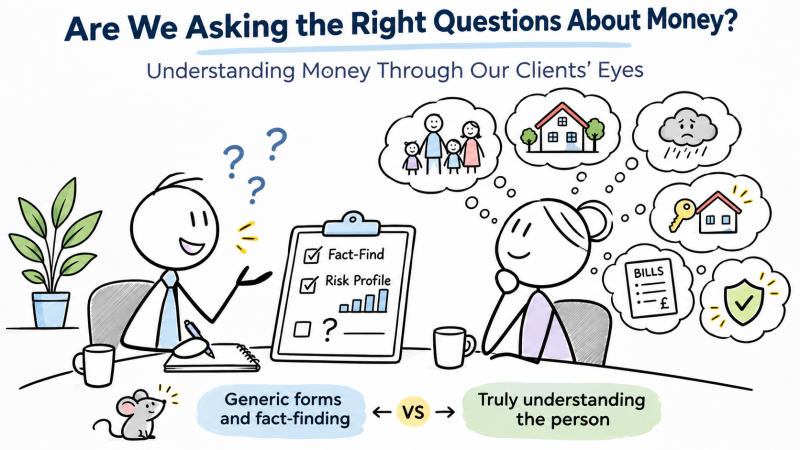
Financial planning can sometimes feel generic
Financial planning firms have a wide range of tools to help them understand clients.
We have fact-finds, attitude-to-risk questionnaires, capacity-for-loss assessments and cash-flow modelling software.
All of these play an important role.
But sometimes I wonder whether the process has become a little too generic.
We ask clients similar questions, collect similar information and produce reports that often follow a familiar structure.
And I understand why. Firms need consistency, good record-keeping and processes that support suitable advice.
But there is a difference between collecting information about someone and genuinely understanding them.
I remember starting work with one financial planning firm and looking at the questions they were asking clients.
What struck me was that many of the questions were about the person rather than their money.
It seems so obvious.
But perhaps when we start by understanding the person, we begin to see their financial decisions from a very different perspective.
The same financial decision, two very different reactions
Let me give you a personal example.
We recently paid off our mortgage early, using some money withdrawn from our pension.
For us, it was an important decision. It meant removing a regular financial commitment and having the peace of mind that comes from owning our home outright.
When I explained what we had done to one financial adviser, their reaction was to question the decision.
Why had we done that? Were we effectively trying to second-guess the direction of investment markets over the next couple of years?
It was a reasonable technical question. Taking money from a pension to repay a mortgage involves trade-offs, including tax implications, the loss of future investment growth and the potential impact on retirement income.
But the conversation was focused almost entirely on the financial calculation.
Later, I mentioned the same decision to a friend.
His response was completely different.
"That's amazing. It must feel so good."
Two people looking at the same decision, but seeing something very different.
My friend immediately understood the emotional value of being mortgage-free.
And importantly, so did our own financial adviser, who had recommended the approach after considering our wider circumstances.
The decision wasn't simply about trying to predict investment markets.
It was about what financial security meant to us.
That doesn't mean the technical considerations were unimportant. They were essential.
But the numbers were only part of the decision.
Sometimes a financial decision that looks questionable on a spreadsheet makes much more sense when we understand the person making it.
Why understanding income and expenditure matters in retirement planning
Another example comes from my work helping financial planning firms develop their retirement propositions.
One area I have consistently encouraged firms to focus on is understanding what clients spend and what they expect to spend in retirement.
Yet I have sometimes heard advisers say that clients won't want to share that level of information.
And perhaps some won't.
But consider this.
Imagine buying a car without knowing whether it needs petrol or diesel.
You might guess, but getting it wrong could have serious consequences.
Now consider retirement planning.
How can we build a meaningful retirement income strategy without understanding what a client needs to spend?
We might know that someone has £750,000 in pensions and investments.
We might understand their attitude to investment risk and have a carefully constructed investment portfolio.
But if we don't understand their expenditure, how can we properly assess whether their resources are sufficient?
How do we know how much income they need, when they might need it or which spending commitments are essential and which are more flexible?
We also need to understand how those needs might change over time.
Retirement isn't necessarily a straight line. Spending patterns may change as people move through different stages of retirement, and unexpected events can affect the plan.
This is why I believe understanding income and expenditure is such an important part of retirement planning.
But there is another element.
We need clients to understand why we are asking for the information.
Start with the person, not the paperwork
Imagine meeting a client for the first time.
We could begin by asking about their assets, liabilities, income and expenditure.
There is nothing wrong with collecting that information. We need it to provide appropriate financial advice.
But what if we started somewhere else?
What if we began by asking what matters most to them?
What are they hoping to achieve?
What would they like retirement to look like?
What worries them about the future?
What does feeling financially secure actually mean to them?
Once we understand those things, perhaps the financial questions become easier to explain.
We are not simply asking clients to complete another form.
We are gathering information that will help us understand whether their aspirations are achievable and what decisions they may need to make.
For example, if a client tells us that they want to travel extensively during the early years of retirement, we can explain why understanding their expected spending is so important.
If another client tells us that their greatest fear is running out of money, we can explore what sits behind that concern and how financial planning might help.
The questions about income, expenditure, assets and liabilities haven't disappeared.
But they now have a purpose that the client can understand.
And that can make a real difference.
Are we listening to understand or listening to respond?
There is another aspect worth considering.
As financial professionals, we are trained to solve problems.
Clients come to us with questions, and we naturally want to provide answers.
But sometimes we can move too quickly towards a solution.
A client says they want to repay their mortgage, and we immediately start calculating whether investing the money might produce a better financial outcome.
A client says they are frightened of investment markets, and we start explaining diversification and long-term returns.
A client says they don't want to spend their retirement savings, and we produce a cash-flow forecast showing how much they can afford to withdraw.
Those may all be perfectly appropriate responses.
But have we first understood why they feel that way?
Perhaps a better starting point is simply asking:
"Can you tell me a little more about why that matters to you?"
It is a simple question, but the answer might completely change the direction of the conversation.
Moving beyond the fact-find
I am not suggesting that we abandon fact-finds, risk questionnaires or financial planning processes.
We need them.
They provide structure, consistency and evidence to support our recommendations.
But we should recognise their limitations.
A completed fact-find can tell us a great deal about a client's financial position.
It may tell us much less about their relationship with money.
Similarly, an attitude-to-risk questionnaire may help us understand someone's responses to investment risk, but it cannot necessarily explain the experiences that have shaped those responses.
That understanding often comes through conversation.
It also takes time.
Clients may not feel comfortable sharing everything during an initial meeting. Trust develops as relationships grow, and what matters to someone can change as their circumstances change.
This is why understanding clients should be an ongoing process rather than something we consider complete once the initial paperwork has been signed.
And there is an important distinction here.
The fact-find helps us understand a client's financial circumstances. The conversation helps us understand what those circumstances mean to them.
We need both.
Better questions can lead to better financial planning
Ultimately, I think this comes back to how we define good financial planning.
It isn't simply about producing an accurate cash-flow forecast, recommending an appropriate investment portfolio or identifying tax-efficient solutions.
Those are important parts of the process.
But good financial planning also involves understanding why clients make the decisions they do.
Why does one client want to hold substantial cash reserves while another is comfortable investing?
Why does someone with considerable wealth remain frightened of spending?
Why might paying off a mortgage be more important to one person than maximising potential investment returns?
We cannot assume that two clients with similar financial circumstances will have similar priorities.
And we cannot always use our own experiences to explain someone else's behaviour.
It starts with listening, asking questions and building a picture of the person in front of us.
Not simply assuming that we already know what they need.
Because perhaps the most important part of financial planning isn't always having the right answer.
It is asking the right question in the first place.
Three questions to think about
As with the other articles in this series, I want to finish with three questions for financial planning professionals.
-
Do your client meetings start with the person or the paperwork? Are you taking time to understand what matters to someone before discussing their finances?
-
Do clients understand why you need certain information? For example, when asking about income and expenditure, do you explain how it helps you build a meaningful financial plan?
-
Are you asking questions that help you understand someone's relationship with money? Or are you primarily collecting the information needed to complete your advice process?
There are no perfect answers, but I think they are worth reflecting on.
Coming next: When Financial Decisions Don't Look Rational
In the next article, I will explore why clients sometimes make financial decisions that appear difficult to justify from a purely technical perspective.
Whether it is holding too much cash, refusing to spend in retirement or prioritising debt repayment over investing, there may be perfectly understandable reasons behind those decisions.
And understanding those reasons can be just as important as understanding the numbers.
This article is part of the Money Wise UK series Understanding Money Through Our Clients' Eyes, drawing on themes from my book Money and Meaning. It is intended to encourage reflection and discussion among financial planning professionals.
Add comment
Comments