
Be careful what you read: pensions, inheritance tax and the bigger picture
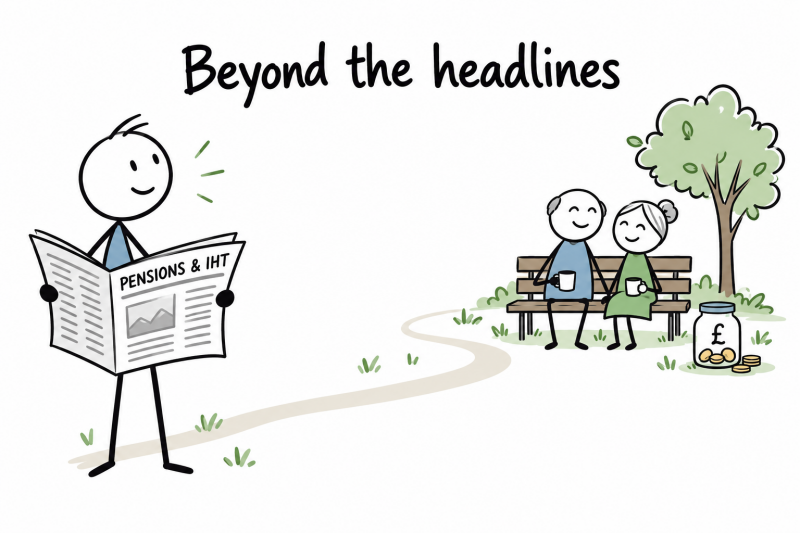
Headlines can make us stop and think. They can also leave us worrying about something before we understand how it applies to our own lives.
The changes to inheritance tax on pensions are a good example. They matter, and for some families the financial impact will be significant. But we should be careful that the debate does not obscure the main reason we build a pension: to help support ourselves, and those who depend on us, throughout retirement.
For many people, the most pressing question remains: will the money last?
From 6 April 2027, most unused pension funds and pension death benefits will be included in a person’s estate for inheritance tax purposes. This does not mean every pension will face a 40% tax bill. The outcome depends on the whole estate, the available allowances and who inherits.
HMRC estimates that, in 2027/28, around 10,500 estates will become liable for inheritance tax because of the change, with approximately 38,500 already taxable estates paying more. It also expects most estates to continue to have no inheritance tax liability. These are estimates, but they provide more useful context than a headline alone.
It is also worth remembering what pensions can offer during the years we are building them.
Take someone aged 20 who pays £160 a month from their own pocket into a pension using basic-rate relief at source. Tax relief adds another £40, bringing the amount invested to £200 a month.
If those contributions continue until age 68, with a steady annual return of 5% after charges, the illustration looks like this:
The £160 a month could grow to approximately £369,209 by age 68. Adding £40 a month in pension tax relief could increase this to £461,511. The £23,040 of tax relief, invested alongside your contributions, could grow to £92,302—because the tax relief also earns investment returns.
These are illustrative future amounts, with no adjustment for inflation. Their purchasing power would be lower than the same amounts today. Nevertheless, the example shows why tax relief and time can make a meaningful difference.
Now consider inheritance tax using a separate example: a retiree with a pension worth the same £461,511, applying today’s allowances and the pension IHT rules taking effect in April 2027. This is a snapshot, not a prediction of tax rules 48 years from now.
Under current rules, someone can normally take up to 25% tax-free, subject to their available lump sum allowance. The standard allowance is currently £268,275 across their pensions. Assuming sufficient allowance remains, this example would allow approximately £115,378 to be taken tax-free, leaving £346,133 invested.
Suppose the tax-free cash has been spent on living costs and experiences, and the remaining pension is still worth £346,133 at death. Assume there are no other assets, debts or relevant lifetime gifts, no spouse or civil partner exemption, and the full £325,000 inheritance tax allowance is available.
The inheritance tax calculation would be:
(£346,133 − £325,000) × 40% = approximately £8,453.
That helps put the potential charge into perspective. However, it is deliberately a narrow example. Add a home, savings or investments and the result could be very different. Taking money out of a pension and leaving it in a bank account does not remove it from the estate.
Nor is comparing the IHT bill with the tax relief a complete assessment of the pension’s tax benefits: income tax on withdrawals also matters.
The often-mentioned £1 million inheritance tax threshold needs context too. Some married couples and civil partners can leave this much without IHT through combined allowances, including the residence allowance where a qualifying home passes to direct descendants. It is not a universal allowance, and the residence allowance reduces for estates above £2 million.
There is another distinction that can get lost: inheritance tax and income tax on an inherited pension are separate taxes.
For a typical defined contribution pension, benefits following death before age 75 can normally be received free of income tax, subject to conditions, including relevant time limits and allowances. From age 75, beneficiaries’ withdrawals are generally subject to income tax at their own marginal rate. Being under 75 does not prevent an inheritance tax liability under the new rules. Where both taxes apply, the rules provide relief so the amount used to meet IHT is not also charged to income tax.
All of this reinforces why retirement planning needs to start with your circumstances.
What income will you and your partner need? How much flexibility do you have if markets fall? What happens if one of you dies, or if care becomes necessary?
Pensions, ISAs and other savings can work together to support that plan. For example, ordinary ISA withdrawals are free of income tax and can help manage how much taxable pension income is needed each year. The right balance will depend on the individual.
Gifting deserves the same care. Helping children or grandchildren can be rewarding, but an outright gift means giving up control of that money. You may need it later.
It may also be possible to nominate grandchildren to receive pension death benefits, subject to the scheme’s rules and any trustee discretion. That is a nomination for after death, rather than giving away your pension during your lifetime, and it does not bypass the new IHT rules.
For some families, inheritance tax will be an important part of the plan. For many others, the priority will be making their savings support a comfortable and sustainable retirement.
Read beyond the headlines. Understand what the changes mean for you. And keep returning to the purpose of the money you have worked so hard to build: supporting the life you want to live.
This article provides general information, not personal financial advice. The growth illustration assumes fixed payments at each month-end, tax relief invested at the same time and a steady 5% annual return after charges. Actual returns will vary and are not guaranteed. Tax treatment depends on individual circumstances, and rules and allowances can change.
Add comment
Comments