
There will be plenty of debate about the triple lock in the months ahead. This blog doesn't take a political stance. Instead, it steps back and asks a more useful question.
How does the State Pension actually fit into your retirement plan?
In short:
- The full new State Pension is £12,547.60 a year in 2026/27. It is expected to rise to £13,036.40 from April 2027.
- For a couple who both get the full amount, that's over £26,000 a year of inflation-protected income.
- The triple lock debate grabs the headlines. The real issue is how you plan around the State Pension.
- Three things matter most: your National Insurance record, your State Pension age, and what happens when one partner dies.
A brief history of the State Pension
It's worth stepping back in time. The State Pension started with the Old Age Pensions Act of 1908. It was means-tested and paid only to people over 70.
It wasn't until 1948 that it became a universal, contribution-based State Pension. Work and pay National Insurance, and you earned an entitlement.
The coalition government introduced the triple lock in 2011. Then, in April 2016, the new State Pension replaced the old basic State Pension for anyone reaching State Pension age from that date.
What is the triple lock?
The triple lock means the State Pension rises each April by the highest of three measures:
- Inflation (CPI) in the year to September
- Average earnings growth (May to July)
- 2.5%
It's worth knowing that the triple lock is a political commitment, not a law. The government suspended the earnings element once before, for 2022/23. That alone is a good reason not to treat it as guaranteed forever.
How much is the State Pension worth?
I've written a lot about how complicated retirement is. And when we plan, we often forget the value of the State Pension.
The full new State Pension is £241.30 a week in 2026/27, or £12,547.60 a year. Earnings rose by 3.9%, so from April 2027 it's expected to reach £250.70 a week. That's £13,036.40 a year. The government will confirm the figure in the autumn.
For a couple who both qualify for the full amount, that's over £26,000 a year.
Now look ahead. Someone 10 years from retirement, assuming increases of just 2.5% a year, could expect around £16,700 a year each. For a couple, that's over £33,000 a year.
To buy a similar inflation-linked income from a private pension, you'd likely need a pot well into six figures. Each.
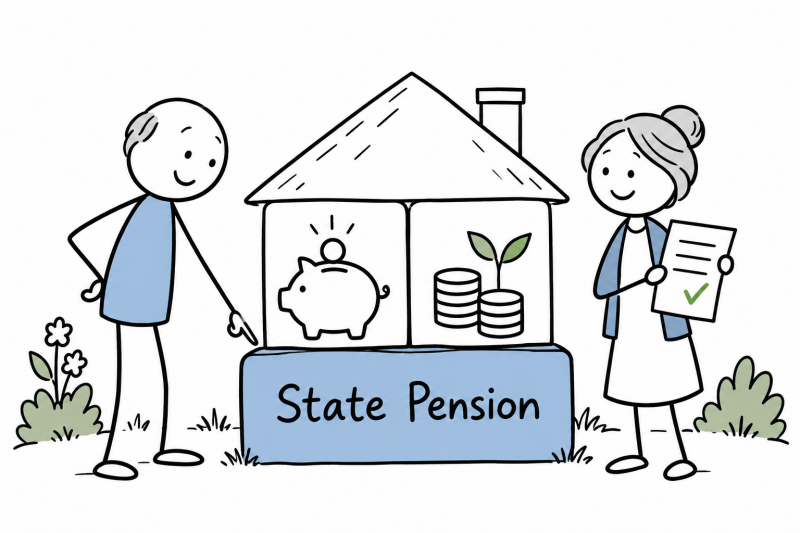
The State Pension has quietly become a significant part of retirement planning. For many people, it's the foundation the rest of the plan sits on.
The real question isn't the triple lock
The debate shouldn't be about when, or if, the triple lock goes. It should be about how we manage our retirement.
We're not only responsible for saving for our retirement. We also have to manage the implications of the State Pension. And they're bigger than most people think.
Three questions to ask about your State Pension
1. Have I paid enough National Insurance?
You usually need 35 qualifying years of National Insurance for the full new State Pension. You need at least 10 years to get anything at all.
Gaps happen. Career breaks, time abroad, self-employment and low earnings can all leave holes in your record.
Start by checking your State Pension forecast on GOV.UK. If you have gaps, you may be able to fill them with voluntary contributions. For many people, this is one of the best-value decisions in retirement planning.
2. When will I actually receive it?
The State Pension age is rising from 66 to 67 between 2026 and 2028. It's currently set to reach 68 between 2044 and 2046.
I won't guess the future. But a government review is already under way, and the move to 68 could come sooner. It's not hard to imagine it moving further out over time.
What does this mean for your planning? If you retire before State Pension age, your own savings must bridge the gap. Every extra year of waiting is another year of income your pension pot has to fund.
3. What happens when one partner dies?
This is the question couples rarely ask, and it matters most.
While both partners are alive, two State Pensions come into the household. When one dies, that drops to one. In most cases, you can't inherit your partner's new State Pension. There are limited exceptions for those with National Insurance records from before 2016.
Yet many household costs don't halve. Council tax, energy bills, insurance and home maintenance carry on. A plan that works comfortably for two can feel tight for one.
The tax issue hiding in plain sight
There's one more point the triple lock headlines tend to miss.
The personal allowance is frozen at £12,570. From April 2027, the full new State Pension is expected to exceed it for the first time.
In practice, that means the State Pension uses up your personal allowance on its own. Any pension withdrawals, rental income or other earnings on top will likely face income tax. This affects how you plan drawdown, natural income and withdrawals from your savings.
Plan on the conservative side
I always say that when planning anything, err on the conservative side. Assuming the State Pension rises by 2.5% a year feels sensibly cautious.
But here's the real picture. Retirement is more complicated than we think. The noise around the triple lock hides a wider planning issue. Perhaps that's where our focus should be.
Check your forecast. Know your State Pension age. Plan for one income, not just two. And understand how it all interacts with tax.
Frequently asked questions
Is the triple lock guaranteed?
No. The triple lock is a government commitment rather than a legal requirement. It was suspended once, for 2022/23, and could change in future.
How much will the State Pension be in April 2027?
The full new State Pension is expected to rise by 3.9% to £250.70 a week, or £13,036.40 a year. The government confirms the final figure each autumn.
How many years of National Insurance do I need?
You usually need 35 qualifying years for the full new State Pension, and at least 10 years to receive any.
Can I inherit my partner's State Pension?
Usually not under the new State Pension. Some people with National Insurance records from before April 2016 may inherit part of a partner's entitlement.
Is the State Pension taxable?
Yes. The State Pension counts as taxable income. From April 2027, the full new State Pension is expected to exceed the £12,570 personal allowance.
This blog is for information only and does not constitute financial advice. Figures are correct as of October 2026 and may change.
Add comment
Comments