
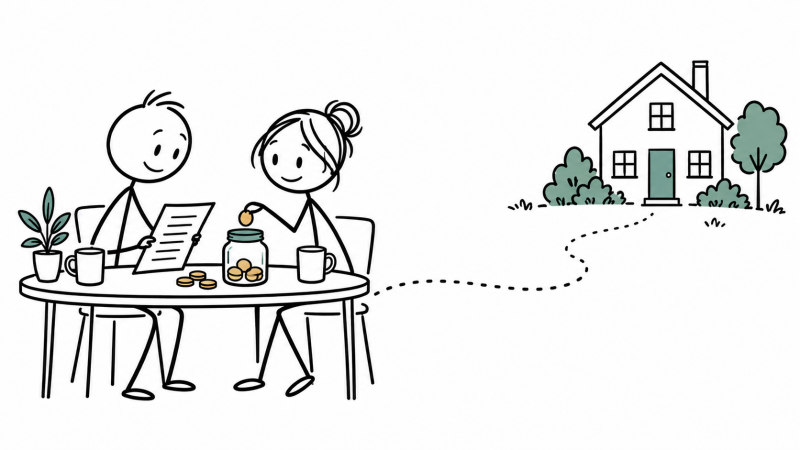
I recently sat down with someone who was thinking about buying their first home. It took me back to buying my own in the early 1990s, when the mortgage and endowment payments swallowed nearly half my take-home pay. There was not much left over.
I have shared before how fortunate I was that my bank manager took the time to teach me the basics of managing money. Those conversations stayed with me. Understanding what came in, what went out and what I could realistically afford made a real difference.
It is tempting to compare that experience with the challenges facing first-time buyers today. But different house prices, interest rates, wages and living costs make it difficult to compare fairly. My experience does not tell me how easy or difficult someone else should find it now.
The more useful question is this: given your circumstances, what might be possible, and what would it take to get there?
Start with the budget
Consider a couple with a combined take-home income of £3,600 a month, after tax and pension contributions. This is an illustration, rather than a claim about what everyone earning the minimum wage takes home. Working hours and deductions matter.
If their total spending were £2,200 a month, that would leave £1,400 to save. Maintained for three years, this would build £50,400 before interest or any government bonuses.
The arithmetic is straightforward. Finding that surplus may be much harder. Rent, childcare, transport, debts and irregular bills can leave little room to save. A budget needs to include those costs, along with some space for enjoying life and dealing with unexpected expenses.
For some people, £1,400 a month will be achievable. For others, it will be nowhere close. The value of a budget is that it gives you a starting point based on your own life.
Understand the help available
A Lifetime ISA may help eligible first-time buyers. Under the current rules, you can contribute up to £4,000 each tax year and receive a 25% government bonus. You must make your first payment before turning 40, and contributions can continue until age 50. [1]
If two eligible people each contributed £4,000 in each of three tax years, they would put in £24,000 between them and receive £6,000 in bonuses. That £24,000 would form part of their savings, not an extra amount on top. In the illustration above, the bonuses could bring the total to £56,400 before interest, assuming all the conditions were met.
There are restrictions. A qualifying home must cost no more than £450,000, and the purchase must be at least 12 months after the first payment into the account. A qualifying mortgage and a solicitor or conveyancer are required. Other withdrawals before age 60 normally attract a 25% charge, which can leave you with less than you paid in. [2]
The government has consulted on replacing the Lifetime ISA with a new First Time Buyer ISA. Its published proposals say LISAs can still be opened until the replacement becomes available, and existing holders can continue under the existing rules. It is worth checking the position when making a decision, rather than assuming an immediate closure. [3]
A deposit is only part of the picture
Building a deposit does not automatically mean a lender will offer the mortgage you need. Income, existing commitments, credit history and the lender’s affordability assessment all influence the decision.
For illustration, a £270,000 property with a £33,000 deposit would require a £237,000 mortgage. This is about 88% of the purchase price. Mortgages with a 10% deposit are available, but availability does not guarantee eligibility. [4]
On a repayment basis over 40 years, a £237,000 mortgage would cost approximately £991 a month at 4%, £1,065 at 4.5%, or £1,222 at 5.5%. These are illustrative rates, not current mortgage quotes, and exclude fees. Actual payments can change when a fixed rate ends.
A longer term reduces the monthly payment but increases the total interest if the mortgage runs for that term. At an unchanged 4.5%, this example would involve approximately £274,000 of interest over 40 years, compared with £158,000 over 25 years. The shorter term would cost around £1,317 a month. A lender would also consider age and likely income over the term.
There are other costs to allow for: legal fees, surveys, moving, any applicable property tax, repairs and an emergency reserve. Once you own the property, maintenance becomes your responsibility, and flats may carry service charges. The mortgage payment alone is not the full cost of ownership.
Finding a balance that works for you
Buying a first home often involves trade-offs. That might mean saving for longer, considering a different location or choosing somewhere smaller. A property needing work can also bring costs and uncertainty, so it is important to be realistic about what you can take on.
I do not think it helps to suggest that everyone could buy if they simply tried harder. Equally, I would not want someone to assume it is impossible before looking at their own figures.
That is where basic financial education can make a difference. A clear budget can help someone see whether a goal is within reach, what needs to change and when it may be sensible to speak to a qualified mortgage adviser.
Getting the balance right means working towards a home while leaving enough room to live in it.
To help you get started, you can download a free budget spreadsheet below.
Money Wise UK provides financial education and information, not regulated financial or mortgage advice. Examples are illustrative and do not confirm eligibility for a product or mortgage. Your home may be repossessed if you do not keep up repayments on your mortgage.
Sources
[1] GOV.UK — Lifetime ISA overview
https://www.gov.uk/lifetime-isa
[2] GOV.UK — Withdrawing money from your Lifetime ISA
https://www.gov.uk/lifetime-isa/withdrawing-money-from-your-lifetime-isa
[3] HM Treasury — First Time Buyer ISA consultation, updated 29 June 2026
https://www.gov.uk/government/consultations/first-time-buyer-isa-consultation/first-time-buyer-isa-consultation
[4] Lloyds Bank — 90% LTV mortgages, included among the original draft’s sources
https://www.lloydsbank.com/mortgages/mortgage-types/90-percent.html
Sources checked 11 October 2026. Savings and mortgage examples calculated independently. Monthly mortgage figures use standard capital-and-interest repayment calculations; total interest assumes an unchanged rate throughout, no fees and no overpayments.
Add comment
Comments